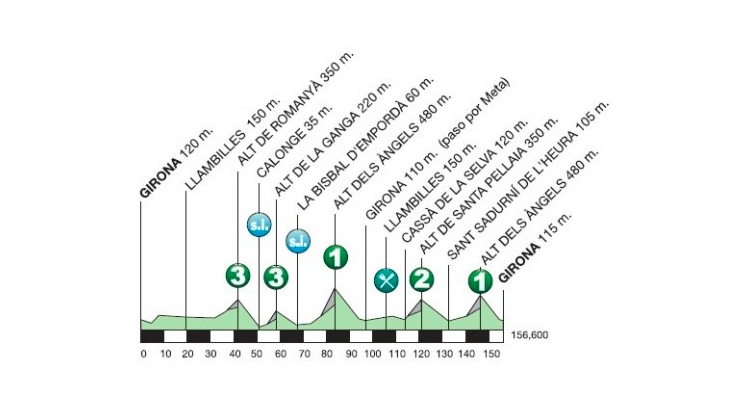
A breakaway surprised the peloton on the opening stage of the Volta and threw the General Classification battle into chaos, and the GC-related surprises continued on Stage 2 when Alejandro Valverde outclassed several sprinters to take a win and valuable bonus seconds. A GC battle on Stage 3 of the Volta a Catalunya, however, would not come as a big surprise: with two Cat. 1 ascents inside the final half of the day, out of five total categorized climbs, this will be a stage that the climbers have marked in the roadbook. The Alt dels Ángels (Category 1, 6 kilometers at a 5.5% average gradient) is the uphill challenge to know here. The riders will crest it for the first time about halfway through the stage, then they’ll hit a Cat. 2, and then they’ll return to the Alt del Ángels once more for a second helping. From the top of that ascent it’s 13 km to the finish, and it’s downhill until there are less than 3 kilometers to go. Attacks launched on the Alt del Ángels could stick. The day’s climbing is not steep enough to be particularly intimidating to the marquee overall contenders, but the race situation after two stages could see the uphill specialists trying to make things happen on the slopes regardless.
With five categorized climbs punctuating the stage, a breakaway is possible here, though the GC teams are extra wary of ignoring the breakers after Stage 1. What’s more, bonus seconds are on the line in this Volta. With several of the top GC contenders sporting fast finishing kicks, the motivation in the peloton to reel in anyone off the front will be high.
One GC contender boasting a particularly speedy finishing kick is the rider who took stage 2. Alejandro Valverde is perfectly suited for this stage. He’s explosive enough on the climbs to try to break free, but a flat finish will make it likely that a small group of aggressors will cross the line here together, and Valverde is deadly sprinting out of a small group. As much of an advantage as the breakaway riders from Stage 1 have here in Catalunya, Vavlerde won’t go down without a fight.
Rigoberto Urán, Giampaolo Caruso, and Wilco Kelderman, all of them also sporting strong sprinting abilities to go with their climbing legs, will all be riders to watch in this scenario as well.
For many of the Cannondale-Garmin riders, these are home roads. This is an excellent profile for Dan Martin, who could be looking to launch an attack on the final ascent. His team knows how to make things interesting on days packed with climbs, and they have the firepower to do so—they might look to put on a show here similar to the one they put on in the 2013 Tour de France when Dan Martin won a mountainous Stage 9 after his team had been on the attack all day.
It’s not out of the question that Alberto Contador or Chris Froome try to make something happen on these climbs, but they aren’t quite steep enough or long enough to favor either of the former Tour de France winners. It won’t be easy for them to get clear here. In Froome’s case, a teammate may be better suited for this stage: Wout Poels tends to thrive on days with repeated not-inhumane climbs.
JJ Rojas, Enrico Gasparotto, and Julian Alaphilippe are among the sprintier types who at least have a shot of surviving. Meanwhile, breakaway-loving Thomas De Gendt probably has this parcours in mind as a perfect opportunity to try to take a long-range victory. He’s way down on GC and not a threat to the overall. Allowing him to make it to the line would not have the same implications for the peloton that their mistake on Stage 1 had. Amets Txurruka and the already-out-of-GC-contention Carlos Betancur are others to watch in a breakaway scenario.
VeloHuman Stage Favorites
1. Alejandro Valverde | 2. Rigoberto Urán | 3. Dan Martin
The WorldTour calendar concludes with the Tour of Beijing, a five-day stage race in and around China’s capital city. The event may be in its final year of existence, but it should provide a good show: plenty of big names have made the trip to China for the farewell party. The race may not have the history or prestige of other stage races on the WT calendar, but it is the last opportunity for the pros to pick up WorldTour wins, and it also tends to see a relatively high number teams filling their squads with younger riders hunting name-making victories. In short, there is still plenty of motivation in the peloton to land results in this race.
The Route
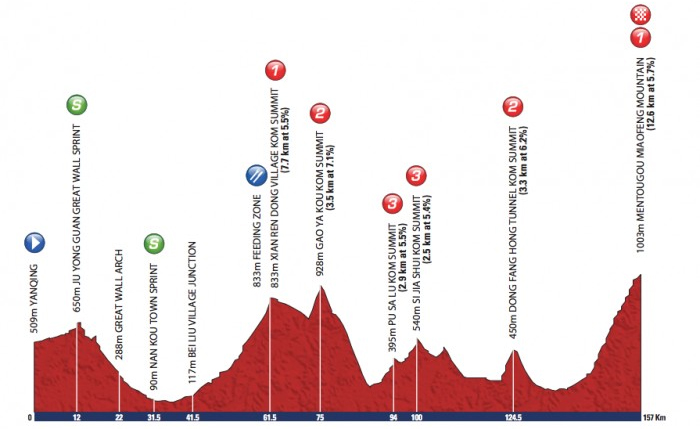
The organizers have added a few extra bumps between the Stage 1 start and the Stage 5 finish, but this race has always had plenty of opportunities for the sprinters and the 2014 edition is no exception. The opening stage has a few early hills but the second half of the stage is mostly flat or downhill, and anything but a sprint finish would be a surprise. Stage 2 offers a few uphill tests, but a long stretch of flat before the finish will favor the faster finishers again. Stage 3 could shake things up, with seven categorized climbs, including a Cat. 1 in the middle of the day and a Cat. 3 crested 11 kilometers from the finish.
Stage 4: Yanqing › Mentougou Miaofeng Mountain (157 km) – The Queen Stage of the Tour of Beijing concludes with a climb of Miaofeng Mountain; this race was won on its slopes last year, and the ascent is likely to be the decisive test in this year’s edition as well.
Stage 4 is the Queen Stage of the Tour of Beijing, and it closes out with the Maofeng Mountain climb that decided last year’s edition of the race (Movistar’s Beñat Intxausti sailed past Dan Martin to take the stage and, ultimately, the time gap that led to his overall victory, on the final slopes). This year, a Category 2 test has been added just before the final ascent to provide extra excitement; this should be the most important GC day in the race. The fifth and final stage starts in Tiananmen Square and heads into an urban circuit that finishes near the National Stadium (typically known as the Bird’s Nest) built for the 2008 Olympics. It’s a pan-flat profile and should see another sprint showdown for the final WorldTour victory of 2014.
The General Classification Contenders
Daniel Martin of Garmin-Sharp is one of a collection of riders who have continually targeted this race, young though it may be, over the past few years. The Irish climber came close to victory last year, but Movistar had too much firepower in the Queen Stage, and Martin had to settle for second. When he has been healthy this year, Martin has been very strong, and coming off his second career Monument victory last weekend, he is obviously on blazing form. He is very well-suited to the Tour of Beijing: this is a short race that is likely to be decided on one or two climb-heavy days, which will give an explosive talent like Martin a chance to showcase his abilities, while limiting the likelihood of a bad day. Ryder Hesjedal will be a very strong second. Garmin has the strength here to fight for the overall victory.
Rui Costa was part of that powerhouse Movistar squad in 2013, coming in 4th overall, but this year he rides as team leader for Lampre-Merida. He has showed strong late-season form, he told VH this past weekend that he’s targeting a big result here in Beijing, and he is always very dangerous in the weeklong stage races at the highest level, with already three podium finishes (including a win) in the World one-weekers this year. Costa is motivated to close out his season with a victory, and should again be in the mix at the top of the leaderboard, especially with a few added challenges in this years race that could favor his brand of aggressive riding on the harder days.
BMC’s one-two punch of Tejay van Garderen and Samuel Sanchez will be hard to counter. At peak form, van Garderen is one of the very best stage racers on this startlist, but his shape, and his motivation for that matter, are a bit of an unknown. Still, it’s been a strong year for the American, and he’s shown some newly developed explosiveness that could make the difference in this race that does offer bonus seconds at the stage finishes. Form isn’t a question for teammate Samuel Sanchez, who was 5th in Il Lombardia last week. His 6th overall finish in the Vuelta earlier this month would suggest that he still has plenty in the tank on the climbs, even at age 36, and he gives BMC another card to play here.
Last year’s winner Beñat Intxausti makes his return looking for a repeat. It’s always hard to judge form with Intxausti, who is so often tasked with riding for Nairo Quintana or Alejandro Valverde, but who does have some real achievements on his palmares; in addition to the 2013 victory here, he has been 2nd in Pais Vasco, 3rd in Pologne, and 8th in the Giro in his still relatively young career. If he is in good shape here, he should be able to contend for another win, though admittedly with just a bit less firepower at his disposal than he had in 2013 when Rui Costa was a teammate. Jesus Herrada, who has had a nice year, will hope to thrive as second in his stead.
Giant-Shimano’s Warren Barguil has looked strong the past several weeks, and his Vuelta Top 10 was a real achievement, especially against such strong competition. With no time trials and a probable mountain showdown for GC honors, the Tour of Beijing would seem to fit him nicely. The 22-year-old mixed it up with some of the best in the world in Spain and he’ll have a chance to pick up his first win of the season here.
It’s been a quiet year for Team Sky’s David Lopez, but the Spaniard took 3rd here last year and he does have a fair bit of uphill talent and the ability to get aggressive on the climbs. Teammate Phil Deignan should thrive on this parcours, and Dario Cataldo, who has put in several big rides this year, can’t be counted out; Sky has options in the race.
Form and motivation are a question mark for Rigoberto Uran, but the Colombian has plenty of uphill talent and a particularly speedy finishing kick in a fight for bonus seconds. If he’s in shape, he’ll be a top contender. Countryman Julian Arredondo of Trek Factory Racing is another star of the Giro who hasn’t had quite the same results late in the year, but he looked okay in Milano-Torino and could be the mix. Teammate Robert Kiserlovski has not landed any big results recently either, but if he can find some of his early season form, he could get involved in the General Classification battle.
Katusha’s Sergei Chernetckii, OGE’s Simon Yates, Esteban Chaves, and Pieter Weening, FDJ’s Alexandre Geniez, and Belkin’s Steven Kruijswijk are on the list of GC outsiders. AG2R sends Carlos Betancur, whose abilities are well-suited to a race likely to come down to one day of climbing, but who hasn’t shown any form since April; Rinaldo Nocentini was 6th here in 2012 and has looked very strong in his past few races, and could be the better bet.
The Stagehunters
Several potential sprint stages have drawn a number of quick men (especially young ones) to Beijing. Luka Mezgec and Sacha Modolo are probably the fastest sprinters on the startlist. Ben Swift put in a decent sprint at Worlds and should be in the mix. Youngster Caleb Ewan of OGE could get involved in the fast finishes, as could veteran Daryl Impey. Other likely sprint contenders are Garmin-Sharp’s Tyler Farrar, Belkin’s Moreno Hofland, Trek’s Danny van Poppel, AG2R’s Davide Appollonio, and OPQS’s Nikolas Maes. Meanwhile, riders like Philippe Gilbert, Edvald Boasson Hagen, Adam Hansen, and Giovanni Visconti could be on the lookout for opportunities to get clear of the purer sprinters when the road gets a little more challenging.
VeloHuman Top 10 GC Favorites
Winner: Daniel Martin Podium: Rui Costa, Warren Barguil Other Top Contenders: Beñat Intxausti, Samuel Sanchez, Tejay van Garderen, Rigoberto Uran, Robert Kiserlovski, David Lopez, Julian Arredondo
That’s it for VeloHuman’s race previews in 2014. I hope you have enjoyed reading them! Be sure to follow VeloHuman on Twitter, and stay tuned for more commentary and analysis during the offseason; the racing may stop, but VeloHuman won’t.
Dan Martin closed out the year’s final Monument Classic with panache, jumping clear of a select bunch inside the last kilometer to deny some fast finishers in the group a chance to sprint for the win. New changes to Il Lombardia’s route certainly played their part in deciding the eventual winner of the race, with none of the many elite uphill specialists on the startlist able to get much separation on the climbs, but that didn’t deter the 27-year-old Irish star: he hung with the lead group and launched a brilliant late strike on the final flat to take the win while many of the of favorites simply watched him fly past. Martin may not have taken as many big results this season as he would have hoped, but his second Monument victory shouldn’t really come as a surprise, as he has flashed his great ability on numerous occasions throughout the year, only to be derailed several times by untimely crashes. After a great ride in La Fleche Wallonne, Martin looked to be in a great position to nab another Monument in the ensuing Liege-Bastogne-Liege and his first Grand Tour Top 10 in the Giro d’Italia. Crashes took him out of contention in both races, but he picked up his first Grand Tour Top 10 (in the Vuelta) and now he’s won that second Monument anyway. An explosive climber with a special talent for the one-day races and currently in his prime, Martin should be a major threat in the hilly classics for years to come.
Movistar’s Alejandro Valverde has been a major threat in the hilly classics for years already, but he followed a familiar script in Il Lombardia, hoping for a reduced sprint at the end of a tough day; that plan didn’t work in Ponferrada last week (where a lack of cohesion in a strong chasing group left Valverde and Simon Gerrans sprinting for the lower steps of the podium behind Michal Kwiatkowski), and it failed again here. As strong as Valverde has been in 2014, his results have included a whole lot of near misses, but I’m not sure he plans on changing his approach any time soon.
Rui Costa landed another big result in a season also filled with near misses, but it can’t be said that he hasn’t given 100% trying to turn those close calls into wins: just as was the case in Montreal, where he finished 2nd, he made the attempt to jump clear late here but was unable to get any space, and still managed to add a nice result to his palmares. In fact, this was his first ever podium in a Monument Classic.
Tim Wellens of Lotto Belisol has been a revelation this year, and his 4th place in Il Lombardia is a nice addition to his already impressive list of achievements in 2014. He has explosiveness and has performed well on difficult profiles throughout the season. He tried to escape from the lead group over the Bergamo Alta, and though he did not succeed, his Top 5 finish in the company of an Olympic champion, a World Champion, and multiple Monument winners is something to be proud of.
The parcours of the new route was not as favorable to Joaquim Rodriguez, who could only manage 8th place after dominating this race in back-to-back years. Fellow climbing specialist Fabio Aru was confident coming into this race and earned a lot of attention as a potential contender, but the last two climbs just weren’t hard enough to launch the pure climbers to victory, and the young Italian had to settle for 9th.
Another rider who will be disappointed with his day in Italy is newly crowned World Champ Michal Kwiatkowski. He spent much of the day very close to the front of the peloton, looking to be in good shape, and with the way the race played out, one might have expected a strong challenge for victory from Kwiatkowski, but he was badly affected by cramps in the last 10 kilometers of the race, suddenly cutting the power to his engine just as things started to heat up. It’s not the result he was hoping for, of course, but it’s been a long season for Kwiatkowski, and now he’ll at least have an opportunity to recharge the batteries before what’s sure to be an exciting 2015 in the rainbow jersey.
With Il Lombardia in the rearview mirror, only one race remains on the 2014 WorldTour calendar! Stay tuned for the preview of the Tour of Beijing, and plenty more analysis as the season comes to a close.
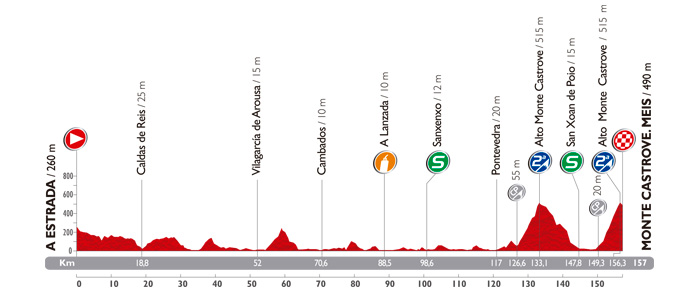
Stage 18: A Estrada › Monte Castrove. Meis – 157 km
Following John Degenkolb’s strong win on the Vuelta’s final real sprinters’ day, Stage 18 will bring to the fore those who prefer charging up a gradient. Very short at only 157 kilometers, Stage 18 nevertheless packs a punch in the finale. After they’ve spent most of the day riding on relatively flat roads, the peloton will have to climb the Alto Monte Castrove twice to close out the day. It’s short, but its 7% average grade will do plenty of damage, and with the finish line coming just over a half a kilometer after the riders crest the climb for the second time, only those with punchy climbing legs will have a chance at being positioned to contest the stage victory.
Since this finish is too difficult for the pure sprinters’ teams to drive the pace, the breakaway will have a chance at staying away on Stage 18, but if Movistar or Katusha decide to keep things on a short leash so that their GC men might have a shot at the bonus seconds on offer, it will be hard for anyone to succeed for afar here. Katusha and Movistar should be keen on controlling this one, because Joaquim Rodriguez and Alejandro Valverde have to be among the top favorites for stage honors. The narrow uphill road of the final climb suits Purito quite well, and it’s hard to imagine him not delivering an all-out attack in the waning moments of the race. Daniel Moreno has just the right skillset for the Alto Monte Castrove as well. Meanwhile, Alejandro Valverde packs quite the uphill kick himself, and he also has the strongest sprint among the riders in the GC Top 5. If he can hold the wheels of the attackers in the last ascent, he’ll have an excellent opportunity to nab a victory and valuable bonus seconds on Stage 18.
Dan Martin has already come close to a stage victory in this race using his top-notch punchy climbing legs, and he has maintained a high level of form even into the third week. He has a great chance here to finally pick up the stage win he’s been hunting. Fabio Aru may not have the Ardennes resume that Purito, Valverde, Moreno, and Martin have, but he is an elite climber who has a knack for exploding out of the pack on the very steep stuff.
Chris Froome is getting stronger every day in this race, and if he can drop his rivals with an attack from far enough out, he’ll have a shot at victory on Stage 18 even on a short climb like this. Race leader Alberto Contador, on the other hand, doesn’t need to attack, and therefore will have the luxury of being able to follow the wheels he wants to follow. That puts him into a good position to pick up another win in much the same way he won Stage 16, when he allowed Chris Froome to drive the pace until an opportunity to fly past presented itself.
Wilco Kelderman hasn’t had quite the level of form in this Vuelta a España that he displayed in the Giro, but he has a very fast finish and is a dangerous rider in a post-climb sprint. Samuel Sanchez, Warren Barguil, and Daniel Navarro are others on the fringes of the GC leaderboard who could hope to get involved in this sort of finish, while Philippe Gilbert and Michael Matthews will hope that they can hang with the GC-oriented climbers on the incline and outgun them in the final few moments for stage honors.
Should a long-distance move take the day, Ryder Hesjedal, Alessandro De Marchi, Luis Leon Sanchez, Adam Yates, Wout Poels, Alexey Lutsenko, Louis Meintjes, and Alexandr Kolobnov are among those who should be considered good candidates for success on a profile that turns hilly quite suddenly in the last 30 kilometers.
VeloHuman Stage Favorites
1. Alejandro Valverde | 2. Joaquim Rodriguez | 3. Dan Martin
Be sure follow @VeloHuman on Twitter for live commentary of this and every stage of the 2014 Vuelta a España! The next preview will be up after the conclusion of Stage 18, and there is plenty of GP Quebec and GP Montreal coverage coming very soon as well, so stay tuned!
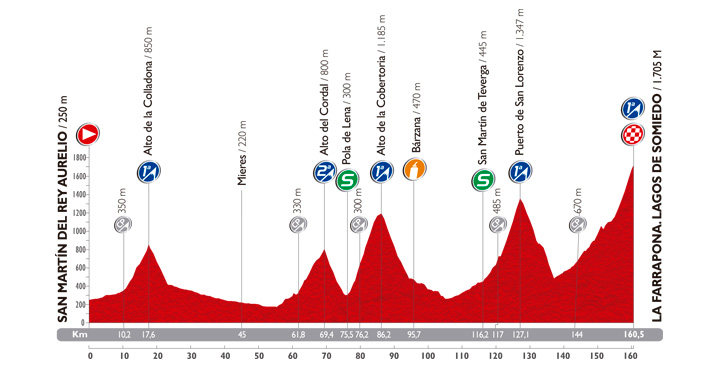
Stage 16: San Martín del Rey Aurelio › La Farrapona. Lagos de Somiedo – 160.5 km
After another tough day won by Przemyslaw Niemiec, Stage 16 closes out a trio of critical mountain stages in style, with no fewer than four Category 1 climbs (and a Cat. 2 thrown in for good measure), and the challenging profile won’t wait until the end of the day to test the peloton. The stage starts with 10 kilometers of slight incline before the first Cat. 1 is reached, the Alto de Colladona. After a tricky descent off the climb the riders will continue to go slightly downhill for another thirty kilometers or so, during which they will try to save as much energy as possible: after kilometer 60, it’s steep climbs or white-knuckle descents pretty much all the way to the finish line. First comes the Cat. 2 Alto del Cordal, followed by a descent right to the foot of the vicious Alto de la Cobertoria climb, a Cat. 1 of 10 kilometers at 8.8% (and it comes only halfway through the stage). From the top, the riders will take on a very technical downhill journey to Barzana, where the negative gradient will become gentler, but it won’t even out completely. When it does, after another 10 kilometers or so, the road kicks up again almost immediately, heading uphill in an uncategorized trip to the bottom of the categorized Puerto de San Lorenzo, another steep slope of 10.1 km at 8.5%. From the top it’s one more tricky descent the leads to one more uncategorized uphill trip to the foot of one more Cat. 1 climb: La Farrapona. It’s a long journey to the summit finish, 16.5 kilometers in total, and though the average gradient may seem manageable at 6.2%, the final 4 kilometers ratchet up the difficulty, with several stretches pushing over 10%.
While the Vuelta’s sixteenth stage is followed by a rest day and is one of the last opportunities the GC contenders will have to put each other under pressure in the mountains (two factors that could spur the red jersey hunters to a fast pace and a more likely catch of the morning break), the profile itself looks perfect for any aggressive riders who manage to get up the road. Early climbs will give the uphill specialists a good chance of getting into the day’s move, and the constant up-and-down will make it very difficult for anyone to control the race. This breakaway vs. GC bunch battle looks to be another tossup, which will again make it difficult to name anyone the clear favorite to take stage honors.
This very steep final climb should be yet another opportunity for Joaquim Rodriguez to get some separation from his rivals on the General Classification. He was unable to get clear of the rest of the red jersey hunters early on the last climb of Stage 15, and then spent most of the rest of the ascent letting Alberto Contador drive the pace, only sailing past in the final few hundred meters to steal a few seconds at the line. However, he won’t have many chances to get ahead after Stage 16, and the slope suits his style nicely. With time running out in this Vuelta, it’s hard to imagine that Katusha won’t look for stage honors and bonus seconds here. Daniel Moreno, as usual, will be a dependable second on these gradients.
Alberto Contador may have lost a bit of time to Rodriguez and Valverde on Stage 15, but only after pulling both of them up the mountain for quite some time. He continues to show impressive strength in this race, and a stage like this, with so many vertical meters on the day, will allow him to put his otherworldly uphill endurance on display.
Chris Froome again landed a good result after riding his own pace up a tough final climb on Stage 15. On peak form, he has the endurance to thrive on a hard stage like this; it will be interesting to see how he does despite not necesarilly being at his best. Alejandro Valverde took 2nd on Stage 15, but his nice result there didn’t necessarily show a whole lot more strength than we’ve seen just yet, as it came with a late jump around Alberto Contador (whom he’d been following for the last several kilometers) in the final few hundred meters. Stage 16 is one of the last chances for the climbers to create some space on the leaderboard, which should lead to more attacks on the final climb, and that will require more from Valverde. If he’s in a lead group in the last hundred meters, his sprint obviously makes him a top favorite, but that scenario will only occur if a lot of things go right for the 2008 winner of this race.
Dan Martin showed immense ability on Stage 15, finishing 11 seconds behind Chris Froome despite spending several kilometers just before the final climb chasing the pack after crashing. He’s far enough behind on GC that he should have a bit of freedom to put in a late dig. Fabio Aru, in a similar position, remains a nice candidate for stage honors with this steep finish if it is, in fact, the GC men who are vying for the day. Robert Gesink, Daniel Navarro, and Samuel Sanchez are others on the fringes of the GC battle who have shown strength in the past few mountain days and who are also good candidates to get clear of the rest of the GC types on the final ascent.
Several potential long-distance protagonists kept their powder dry and stayed in the pack on Stage 15. Ryder Hesjedal was one of them, but he did expend a lot of energy dragging Dan Martin back to the GC group after Martin’s crash. He’ll still be among the favorites if he gets into the day’s move, but it would be an impressive ride indeed if he were to succeed here after two tough days on the bike. David Arroyo was 8th on the stage that Hesjedal won from the break, and this will be another great opportunity for the pure climber to try for a long-range strike. Teammate Amets Txurruka is a good candidate to give it a go as well. Esteban Chaves has fallen out of GC contention in this Vuelta, and he could be hoping to get into the break on Stage 16, which has a steep finale that suits him; teammate Adam Yates is another likely long-distance hopeful. Astana’s Mikel Landa, Stage 15 winner Przemyslaw Niemiec of Lampre-Merida (if he still has anything left in the tank after two days in the break), his teammate Damiano Cunego, Belkin’s Laurens Ten Dam, OPQS’s Gianluca Brambilla and Wouter Poels, MTN-Qhubeka’s Sergio Pardilla and Louis Meintjes, Lotto Belisol’s Bart de Clercq, and Cannondale’s Alessandro De Marchi are other good candidates for breakaway success.
VeloHuman Stage Favorites
1. Joaquim Rodriguez | 2. Alberto Contador | 3. Daniel Martin
Be sure follow @VeloHuman on Twitter for live commentary of this and every stage of the 2014 Vuelta a España! With a rest day on tap after Stage 16, the next preview will be up on Tuesday, so stay tuned for more.
Heavy favorites Orica-GreenEdge probably didn’t need much help on Day 1, but they got it anyway, starting early enough to avoid some pouring rain. Their time withstood spirited efforts from Team BMC and Omega Pharma-Quick Step, putting Svein Tuft into the pink jersey for Stage 2. Movistar turned in a disappointing performance in the wet weather that left Nairo Quintana almost a minute back on rivals Rigoberto Uran and Cadel Evans. Uran and Evans have even bigger gap (about a minute and a half) on Joaquim Rodriguez, whose Katusha squad had a rough day. But by far the biggest story of Stage 1 was the nasty crash that took down Garmin-Sharp’s Daniel Martin and three other riders. Martin lost control on what appeared to be a rainslicked manhole cover, and went down very hard, breaking his collarbone and ultimately abandoning the race. After a heartbreaking crash ended his hope of winning Liege-Bastogne-Liege, Martin’s fortunes in 2014 have turned even worse. The would-be GC contender (and member of the VH pre-race Top 10) saw the biggest goal of his season slip away in the blink of an eye. Teammate Ryder Hesjedal was not one of those who crashed, but the squad had already dropped one of their members earlier in the course, and as team time trials are judged according to the performance of the fifth best rider, Hesjedal and the others who survived the incident were forced to stop and wait for Fabian Wegmann to catch back up and bring their number to five before they could continue. Rolling across the line in last place and almost three and a half minutes down, Hesjedal’s GC hopes are already dashed as well.
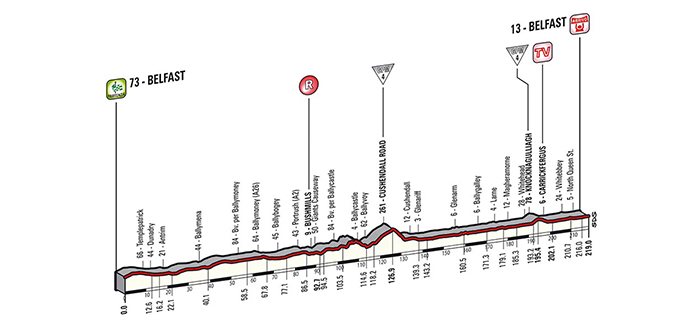
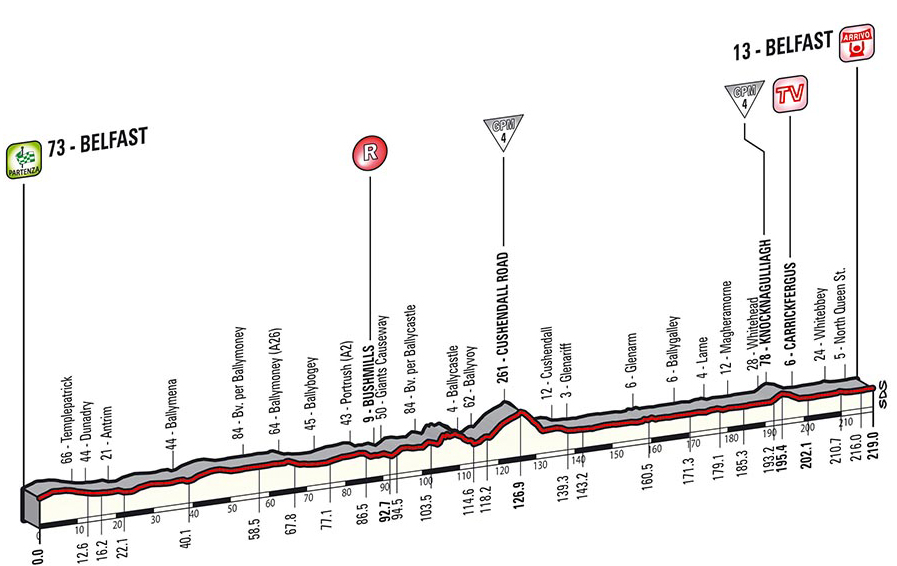
After an eventful opening chrono, road racing begins in earnest Saturday morning. Stage 2 also begins and ends in Belfast. It’s a 219 kilometer loop with only a pair of Category 4 climbs to challenge the peloton. The profile won’t provide many opportunities for riders to get away, and this early in the race, GC teams will look to marshal breakaways quickly. However, the first sprint stage of a Grand Tour is always a hectic affair, and the jockeying for position will be aggressive. Furthermore, it could rain, and winds will be high on the coastal roads. Today’s conditions proved perilous, and not just for Garmin; no one else got into any serious incidents but a number of other teams had riders slipping and sliding around the corners. With a high intensity sprint stage on tap for tomorrow, things could get hairy. It will no doubt be a nervous journey from start to finish.
Should everyone manage to stay upright, this stage is very likely to end in a bunch sprint. Without many obstacles to slow him down, Marcel Kittel is the heavy favorite. Kittel was the best sprinter at last year’s Tour de France; in this Giro, without either of the sport’s other two top fast men, the gap to the next best sprinter is significant. He also benefits from a team completely committed to his cause—and GSH knows how to set their sprinters up for victory. In the event that Kittel does somehow get dropped before the final kilometers, Luka Mezgec is an attractive second option, on nice form this year.
The two men with the best chance to take on the GSH juggernaut will be Cannondale’s Elia Viviani and FDJ’s Nacer Bouhanni. Viviani is coming off a Tour of Turkey in which he beat Mark Cavendish in two stages, so it will be interesting to see him matched up against another of the top finishers in the game. Bouhanni has already collected several wins this season, but most of them have come against lower level fields. We’ll see how he does against Grand Tour competition.
Michael Matthews will hope to be the next pink jersey wearer for Orica-GreenEdge. Prognosticators often focus on his versatility, but don’t forget that he really does have the top end speed to be in the mix on a sprint stage. The also versatile Ben Swift of Team Sky looks very sharp this year. On the other hand, it’s always a possibility that Sky will go with Edvald Boasson Hagen, also speedy. Trek’s Giacomo Nizzolo seems to be back on form after his collarbone injury, and he has a nice team around him as well. Alessandro Petacchi rides for an OPQS outfit that knows how to handle the crosswinds. Should the conditions shake up the state of affairs on the stage, Petacchi could be a dangerous contender, and coming off a strong TTT, there is a slight chance that he could find himself in the pink jersey if he is among those benefitting from bonus seconds on the day. Garmin-Sharp will be shifting their focus to stage wins now that Martin and Hesjedal are out of contention for the pink: Tyler Farrar looks much improved this season.
Unless the rough conditions cause some sort of major shakeup, it’s hard to see anyone beating Kittel on the day, and really hard to see anyone other than the above names pulling off that surprise, but for further outsiders, look to AG2R’s Davide Appollonio, Neri Sottoli’s Francesco Chicchi, and Tinkoff-Saxo’s Manuel Belletti.