Tag: Diego Ulissi

  • Giro d’Italia 2014: Stage 5 Preview

    Giro d’Italia 2014: Stage 5 Preview

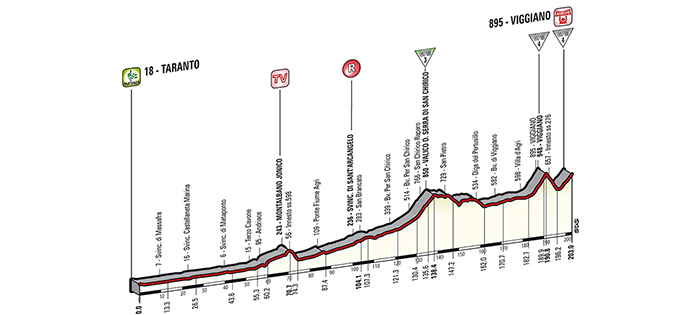
    Stage 5 Profile

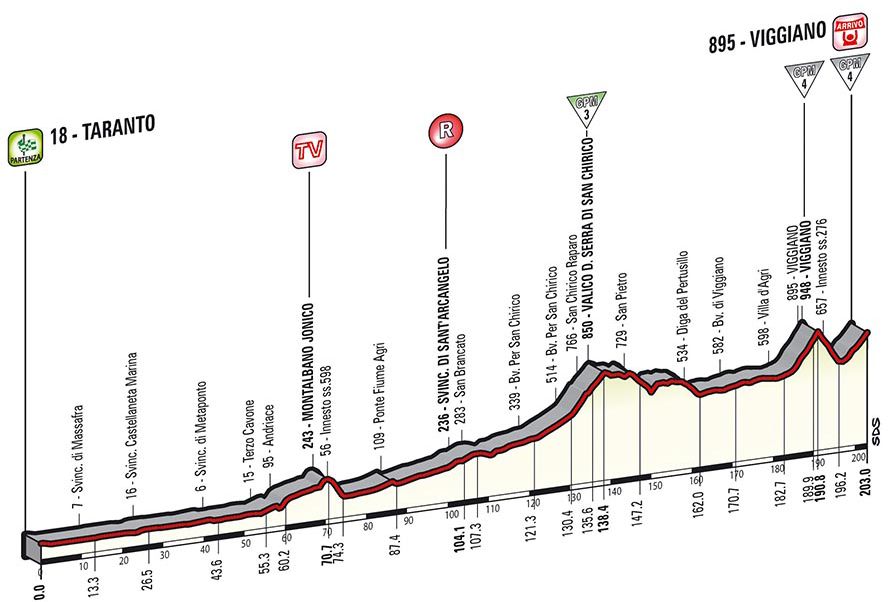
    Stage 5: Taranto > Viggiano – 203 km

    Stage 4 of the Giro d’Italia was a strange one. The abandonment of Marcel Kittel was the first big news event of the day. A fever laid the German fast man low, opening the Giro’s sprint stages up to a number of other contenders who had been relegated to also-rans by his presence early in this race. The loss of Kittel wouldn’t be the only big story of Stage 4: nasty weather hit Southern Italy as the contest kicked off, and the peloton decided that the roads were just too dangerous. The riders themselves decided to neutralize the early racing, and eventually the commissaires made the official ruling: times for GC would be settled at the penultimate lap of the finishing circuit, and then the sprinters would get their opportunity to fight for a win, albeit without any bonus seconds on offer. All of the major contenders made it safely to the new finish line, and then it was a mad final lap around Bari for the fast men. Nacer Bouhanni suffered a late mechanical but made his way (albeit with some moto-pacing) back to the bunch. Cannondale looked well-placed as the finish line neared, but most of their leadout went down in a sudden crash on the wet roads. From the carnage, Giant-Shimano seemed to emerge in the best shape, but Luka Mezgec dropped a chain in the final moments. Tom Veelers made a strong effort to pick up the slack on his own, but he was passed in the last few meters. Nacer Bouhanni took his first Grand Tour stage win, with Nizzolo just behind.

    After three straight flat sprint finishes, Stage 5 will finally offer a venue for a new show. There are three categorized climbs on the course: the first, a Cat. 3, comes at the end of a very long stretch of uphill road, and is crested 138.4 kilometers into the race. It’s not a steep journey but it will inject a bit of tiredness into heavier legs. A little over 40 kilometers from the top of that ascent, the peloton will start the climb toward Viggiano. It’s a Category 4 affair into town and the first passage of the finish line, and then a circuit around Viggiano that involves a technical descent and a Cat. 4 climb to the line for the second and final time. The uphill finish is not an overly demanding one, but it’s likely to bring a mostly different cast of players to contest the victory than we’ve seen so far. From the bottom of the aforementioned descent it’s about 6.5 uphill kilometers to the finish line. The majority of the way up is taken at around 3%, but the final kilometer rises to 7%, which practically guarantees the Vivianis and Nizzolos will be outgunned by lighter types.

    Not many of the sprinters who have been active on the opening stages have any real shot here. OGE’s Michael Matthews is an exception. He has had this stage on his mind from the outset. He is at his strongest in a sprint with a bit of a gradient when his heavier rivals are unable to match his pace. The big question for Stage 5 is whether the late 7% might be too steep. Past results would suggest that Bling excels in the realm of 4% and even 5%, but it’s hard to say whether he’s built for this steep a finish. The Sky duo of Ben Swift and Edvald Boasson Hagen are the other possible exceptions. Sky has backed Swift so far in this race and he, too, will love the chance to charge for the line without the likes of Viviani and Bouhanni alongside. However, I wouldn’t be surprised to see the team behind EBH on this gradient.

    While even the most versatile sprinters will be hard-pressed on the slope, it will be a welcoming challenge for a number of riders who specialize in finishing fast uphill. Lampre-Merida’s Diego Ulissi is the name that stands out the most. He will love the profile. He outmatched Liege-Bastogne-Liege winner Simon Gerrans in an uphill drag at the Tour Down Under earlier this year, and after a disappointing running in the Ardennes, I think he’s hungry for another win in his home country. The form is definitely a question mark, as he hasn’t picked up any big results in a while, but the skillset is almost perfectly matched for the finish here. Garmin-Sharp’s Nathan Haas is a real outsider with the bookmakers, but he is another rider I like for this stage. He also made quite a splash at the Tour Down Under, showing on a number of occasions a faster finish than most expected, especially when hills were involved. Unfortunately, he went down in Garmin’s nasty Stage 1 crash and seemed a bit banged up, making his health the biggest unknown; however, he’s been finishing with the pack in the stages since, and he’s also had a rest day and then mostly neutralized stage to recover. If he is indeed close to 100%, I think he’ll be very dangerous against some better known names for Stage 5. Other specialists who will be targeting this opportunity for an uphill sprint include Astana’s Enrico Gasparotto, Bardiani’s Enrico Battaglin, Trek’s Fabio Felline, Giant’s Simon Geschke, Cannondale’s Oscar Gatto and Moreno Moser, and Neri Sottoli’s Simone Ponzi (who has looked great this year and will love a chance to show Astana that they made a mistake by letting him go in the offseason).

    A number of General Classification contenders could be on the hunt for stage glory and bonus seconds, and I expect to see some of them at the front in the final moments. Daniel Moreno is perfectly suited for this finish, but Katusha has already had a number of struggles early in the Giro, so it could be all hands on deck for Joaquim Rodriguez. He prefers steeper, but he’s got a nice uphill sprint no matter the gradient. The same is true for Rigoberto Uran of OPQS. BMC’s Cadel Evans is surprisingly quick to the line even at lower grades, and he loves to fight for bonus seconds. Teammate Samuel Sanchez is a dangerous uphill charger as well. Haas’s teammate Ryder Hesjedal and Ulissi’s teammate Damiano Cunego could feature. Trek’s Julian Arredondo is another climber who shows a nice burst of speed when necessary.

    VeloHuman Stage Favorites

    1. Diego Ulissi | 2. Cadel Evans | 3. Michael Matthews
    Outsider to Watch: Nathan Haas

    The preview of Giro d’Italia Stage 6 will be up not long after the Stage 5 finish. If you missed it, the overall Giro d’Italia preview can be found here. Also, be sure follow @VeloHuman on Twitter for more analysis of the Giro, and of the Tour of California as well. Rohan Dennis won an important Stage 3 in that race today and took back some time against Bradley Wiggins on GC. I’m not previewing California but I will be tweeting plenty of pre-race thoughts and picks for the stages to come.

    -Dane Cash

  • Tour Down Under 2014 Post-race Impressions: Big Names Battle for the Year’s First Big Win

    BehindCadel

    Recapping 2014’s First WorldTour Race

    When the season is in high gear I’ll only be recapping the bigger races or the blocks of bigger races (ie., the Ardennes week), but there are over thirty WorldTour-less days ahead and the six day race that finished in Adelaide on Sunday is more than worthy of some analysis. As such, I’ve compiled a few takeaways from the big January event.

    Any sort of retrospective on the Tour Down Under that aims to draw conclusions with meaningful predictive power ought to make a clear disclaimer before offering any emphatic endorsements of this rider or that for the new year: due to its position on the calendar, more than a month before the next race at the highest level of the sport, the Tour Down Under is not always a reliable test of rider form for a new season. Cameron Meyer, who won the 2011 edition, and Tom-Jelte Slagter, winner of the 2013 TDU, proceeded to have anonymous seasons after their bright victories in Australia to start the season. Simon Gerrans, on the other hand, went on to nab his first career Monument classic victory after he won the 2012 edition of the race. In other words, perhaps the top form exhibited again by Gerrans this week is a sign of future success (and he is targeting Milano-San Remo again this year), or perhaps it is a poor indicator of probable form months from now: the point is simply that one ought to be careful drawing too many conclusions from this race.

    The Narrative, and Takeaways from the Race

    Caveats made, on with the analysis. The GC-leading quartet of Simon Gerrans, Cadel Evans, Diego Ulissi, and Richie Porte were all particularly impressive in their 2014 WorldTour debuts. Only one second separated 1st and 2nd place, and only ten seconds separated 1st and 4th; all four won stages. Gerrans was a big favorite coming into the race (tipped by yours truly to win), and the other three were also included in VeloHuman’s pre-race top 10, so it can’t be said that there was all that much surprising at the very top of the General Classification. For what it’s worth, Gerrans looked on top form and displayed his trademark versatility, climbing with the best and sprinting for every possible second; should he maintain that form into the spring, the rest of the peloton had better watch out. Said versatility nabbed him the bonus seconds necessary to get the tiniest of legs up on Cadel Evans for the overall victory. Evans and Richie Porte both put in strong performances showing their own high level of form. Both are targeting later season Grand Tour success, and this certainly looks to have been a fine start; Porte looks to be aiming for success at the Giro this year, and after seeing potential main Giro Nairo Quintana take an emphatic win in the Tour de San Luis this week, the Sky rider will be happy to have had some success of his own in the meantime.

    PorteWinning

    Of the foursome that quickly become the group of real contenders in this race, Diego Ulissi stands out to me as the rider whose performance is most worthy of a place in any analysis of this race’s “takeaways.” In 2011, the Italian put himself on the map with a Giro stage win, and he went on to pick up a number of smaller Italian races over the next year or so. Last year, he appeared to reach another level with a good showing in Paris-Nice and a stage win in the Tour of Poland before a hot October that saw him nab three Italian one-day race victories, including prestigious semi-classic Milano-Torino. However, so many of his successes have come either against weaker competition or at just one step below the highest level of the sport–and while his combination of explosive climbing and fast finishing have marked him out as one to watch, but he’s also disappeared on some of the larger stages. When he was not lighting up the Italian semi-classics, he was a DNF in the World Championship race and an also-ran at Il Lombardia. In the 2014 Tour Down Under, however, he went up against some of the sport’s very best and consistently performed at the elite level. He blew past Evans and Gerrans in Stage 2 after timing his sprint perfectly, and held onto his high place all the way through to the end, managing his podium spot with a total of four top 5 finishes in Australia, and it is that day-in, day-out consistency that he has been lacking. After this, I know I’ll be more confident tipping Ulissi to hold his own for more than a flash of brilliance in future races.

    24 year old Nathan Haas proved to be perhaps the biggest surprise of the race. Although he won the 2011 Japan Cup Cycle Road Race with his impressive finishing kick and claimed 2nd in the 2012 Tour of Britain to Jonathan Tiernan-Locke, Haas has not had many chances to shine at the WorldTour level against the biggest names around. Not until this past week, at least. When pain from a pre-race injury proved to be the end of GC hopes for Rohan Dennis, Garmin-Sharp didn’t miss a beat, and Nathan Haas stepped right up to the plate. While he’s obviously showed ability in the past, I think it’s safe to say that not many people expected him to finish in the top 20 of every stage in the Tour Down Under, including a second place finish at the head of the bunch sprint behind Cadel Evans on stage 3. His consistent performance landed him 5th overall in the Tour. It will be interesting to see if Garmin quickly gives him another opportunity to follow up on his stellar trip home to Australia. Hopefully, we will have a chance to watch Haas building on this week again soon.

    Geraint Thomas wasn’t really a surprise in the top 10, but it was nice to see him climbing at such a high level. As I said in the initial preview, I feel that much is said about Geraint Thomas despite a general lack of data, but his 8th place here, only a few seconds behind proven climber Robert Gesink, is another positive showing, especially given the fact the Sky was clearly riding for Richie Porte in this race. Daryl Impey, as well, wasn’t a big surprise in the top 10, but to land in that company while also riding in such successful support for Simon Gerrans is no small feat–Impey has really put together a fine last twelve months, and Orica-GreenEdge has surely taken note. Look to see Impey feature more as the main man for the Australian squad in races to come this year.

    Though his legend has grown as he has built an amazing streak of consecutive Grand Tour appearances, Adam Hansen has only claimed a few major successes in his career (most notably, a Giro stage last year). However, the Australian nabbed the King of the Mountains jersey and a spot in the top 10 overall in the Tour Down Under with a noteworthy combination of the aggressive style necessary to pick up mountain points in a break and the endurance necessary to hang on in the bunch after being swept back into the peloton. His Lotto-Belisol squad, so often a sprint-first team, has got to be pleased with the showing, and they must be looking forward to the next race knowing that Hansen has what it takes to stay out front for the long haul, proudly displaying the Lotto-Belisol logo.

    Speaking of Lotto-Belisol and sprints, there wasn’t really any question of competition in the two flat days at this year’s TDU. Andre Greipel blew away his opponents, and he did it largely thanks to his dominant leadout train. In stage 4, his leadout man Jurgen Roelandts was so strong that he finished 2nd behind Greipel himself and ahead of the designated sprinters of every other team in the race. Greipel’s stage 6 leadout was similarly impressive; from the moment he kicked it was clear the Gorilla would claim the day. Coming into the race, the sprints in this Tour looked to be a battle royale between Marcel Kittel and Andre Greipel, but Kittel was anonymous throughout the week, his only success in Australia a victory at the warm-up prelude, the People’s Choice Classic. At age 31, Greipel is still riding high, and his leadout only gets better with time.

    Astana and Movistar both failed to land any of their very talented squads in the top 10, which must be a letdown for both teams; Francesco Gavazzi and Javier Moreno both started well only to be left in the dust when Cadel Evans forced serious selection on stage 3. Trek’s Frank Schleck also had a rather forgettable trip to Adelaide, unable to hang on when the going got tough. That Katusha’s squad of unknowns could place a man in the top 10 (chapeau to Egor Silin, by the way!) must not sit well with any of those teams.

    Fortunately, everyone gets another shot at glory relatively soon, as, even with a fair bit of time until the next big race, the 2014 season is officially underway. The Tour Down Under gave us a first glimpse at many of the big names in the pro peloton and the early classics should be a good opportunity for guys like Simon Gerrans and Diego Ulissi to show of continued form. Don’t forget about races like the Volta ao Algarve and the Tour Méditerranéen Cycliste Professionnel during the month and a half long drought before the next WorldTour race, Paris-Nice.

    -Dane Cash

    Photos by Kym Della-Torre.

  • Post-year Impressions: Charting the Arrivals and Step-ups of 2013

    HesjedalCostaBetancur

    2013 is in the books! Beñat Intxausti won the GC of the final WT race of the year, the Tour of Beijing, by taking a victory on the decisive fourth stage. Joaquim Rodriguez finishes the year as repeat WorldTour champion on the back of his GrandTour successes, a Monument victory, and a truckload of high placings in other big races.

    As this site is in the business of prospective analysis, my look back at 2013 will mostly be a look forward. I hope to shed some light on what we learned about the top riders in the sport this year, and which riders to watch in the future. If you’re reading VeloHuman, you don’t need me to tell you that Chris Froome is a rider to keep an eye on next year, or that Vincenzo Nibali is shaping up to be his main rival, or that Fabian Cancellara is still a talented racer. Instead, it’d be more productive for me to focus on the riders who made vast improvements in 2013, who we might say “arrived” this year, and who have set themselves up to do big things next year, so I’ll do just that, and name some names that I think made big strides this season and look to continue to do soon in the near future.

    A rather obvious duo headlines my list of the most emphatic arrivals this year. While everyone was busy wondering which Spaniard would present the best case against Chris Froome in the Tour de France, a 23-year old Colombian leg-muscled his way onto the scene, building off of early season success in the Tour of the Basque Country with a fierce display of climbing prowess on some of the Tour’s most difficult stages: Ventoux, Alpe d’Huez, Mont Semnoz. Though the early lead Froome had built up was insurmountable, Quintana’s later stage performances, matching the Sky captain’s every move uphill on his way to 2nd overall, a stage win, the polka-dot KoM jersey and the young rider’s white, he saved Movistar’s Tour after their team leader Alejandro Valverde hit some raw luck with a mechanical that dropped him out of contention. No one will overlook him next year, especially with such a climbing-oriented 2014 edition of the Tour de France on the docket. Alternatively, he could set his sights on the Giro. Quintana’s time trialing might need a bit of work, but he showed this year that he can outclimb most of the sport’s biggest names, and you have to think he can only get better, still a few years shy of his prime.

    Countryman Carlos Betancur blazed onto the scene with similar brightness. Top 10s at La Fleche Wallonne, Liege-Bastogne-Liege, and the Tour of the Basque Country were followed by a highly successful Giro d’Italia, in which the young Colombian took 5th overall and the young rider classification. Like Quintana, he is sorely lacking in the time trialing department—his remarkable Giro was made all the more remarkable by his appearance in the top 10 after losing almost five minutes to the eventual winner of the race in the first ITT. Like Quintana, he’ll gun for future Grand Tour success in chrono-light parcours while he improves in that discipline, and while he may be a shade shy of Quintana’s level on the longer Tour style climbs, he’s more explosive than the Movistar wunderkind, and will surely be a fixture in the climber’s classics to come.

    Zdenek Stybar is my other most emphatic arrival of the year. His situation is unique, in that cycling fans have heard Stybar’s name for years, but in a different discipline. Making the switch from cyclocross appears to have worked out for the Czech rider: even after a collision with a fan robbed him of a potential podium position in Paris-Roubaix, he still finished 6th in that race, and followed it up with a dominant Eneco Tour and a beautiful stage win in the Vuelta where he outsprinted none other than former World Champ Philippe Gilbert. His versatility was dazzling, and he will go into the 2014 classics season as a hot favorite across all kinds of terrain—and isn’t that the perfect expectation for a former cyclocross world champion?

    Many other riders who were already well within the sights of cycling fans took leaps onto the highest level. Outside of Quintana, the most emphatic arrivals among riders who finished the year in the WorldTour top 10 were made by Dan Martin and Rui Costa. Dan Martin was already a name on the minds of observers at the start of the season, with a Grand Tour stage win in 2011 and the overall victory at the Tour de Pologne in 2010, but he took a Monument Classic, a Tour de France stage win, and the overall at the Volta a Catalunya this year, successes that vaulted him to 6th place in the final WorldTour rankings of 2013 (putting him ahead of Spartacus himself). And Rui Costa came into the year as a well-known talent as a winner of a Canadian GP, the Tour de Suisse, and a stage in the Tour de France, but his two Tour de France wins and World Championship (to go with another dominant Tour de Suisse) put him at cycling’s center stage. He goes to Lampre in 2014 as the team leader, a Tour de France GC hopeful. Another star of the Tour, Bauke Mollema was already a well-known name for many fans of the sport, having finished 4th overall and 1st in the points classification in the 2011 Vuelta, but he came into his own this year with strong performances all over the calendar, in the Ardennes Classics, the Tour de Suisse, Tour de France, Vuelta (where he won a stage to redeem a disappointing GC effort), and Clasica de San Sebastian. His emergence comes at just the right time, with teammate Robert Gesink having another disappointing year in terms of Grand Tour GC contention; however, Gesink showed strong late season form in shorter races, winning the Grand Prix Cycliste de Quebec and placing highly in other events, suggesting a possible change of focus to shorter races going forward. And the timing was ripe for Marcel Kittel to make an explosive entrance: after injury in 2012 robbed him of an opportunity to make his mark on that year’s tour, his 2013 outing, which earned him a quartet of stage wins, suddenly sees him in the best-of-the-best conversation with Mark Cavendish and Andre Greipel.

    In case you missed it, his teammate Luka Mezgec was one of a number of young up-and-coming sprinters who showed promise this year. Mezgec spent the whole year nipping at the heels of other sprinters, racking up countless top 5s without a win until he finally picked up his first of the year and his first WT level win ever on the very last day of the WorldTour calendar in Beijing. Nacer Bouhanni took a pair of wins in that race to go with the points jersey, as well as a number of other wins this year, a boon for FDJ. His squadmate Arnaud Demare took stages in the Eneco Tour and the Tour de Suisse, an armful of honors in the Four Days of Dunkirk he won, and high placings in a number of one-day races. Yet another French, Europcar’s Bryan Coquard, a former track cycling star, transitioned quite nicely onto the road, collecting honors left and right on the Continental circuit. The 21 year old will be a major force on the fast finishes in 2014 now that Europcar looks to be joining the top division of teams. Michael Matthews came into the Vuelta flying high after Continental Tour success and proceeded to establish himself as the best sprinter in that race, with a special talent for nabbing victories after tough days in the saddle. His skills nabbed him a pair of stage wins, including the victory on the final day’s sprinter battle royale.

    Speaking of quick hardmen, Alexander Kristoff gets a paragraph of his own: he built on a strong 2012 (in which he took an Olympic Bronze Medal) with top 10s in three Monument Classics and his first WorldTour level win in the Tour de Suisse (besting Peter Sagan on a tough day that ended in a sprint). He has established himself as a serious contender for hardman sprinter’s races going forward.

    The Vuelta gave us an opportunity to see a number of coming out parties for GC contenders. Leopold Konig landed in the top 10 and picked up a stage win at the head of a Pro Continental team, quite a feat for the 25 year old. He’ll stay with NetApp for another year and will hope his performance garners further invitations to big events, where he’s sure to continue his success. Meanwhile, Saxo-Tinkoff’s Nicolas Roche achieved some long awaited success with a top 5 finish and a stage win. His constant presence at the front of the pack on mountaintop finishes in Spain suggests that he may finally have taken the step up to the next level, a good sign for 2014.
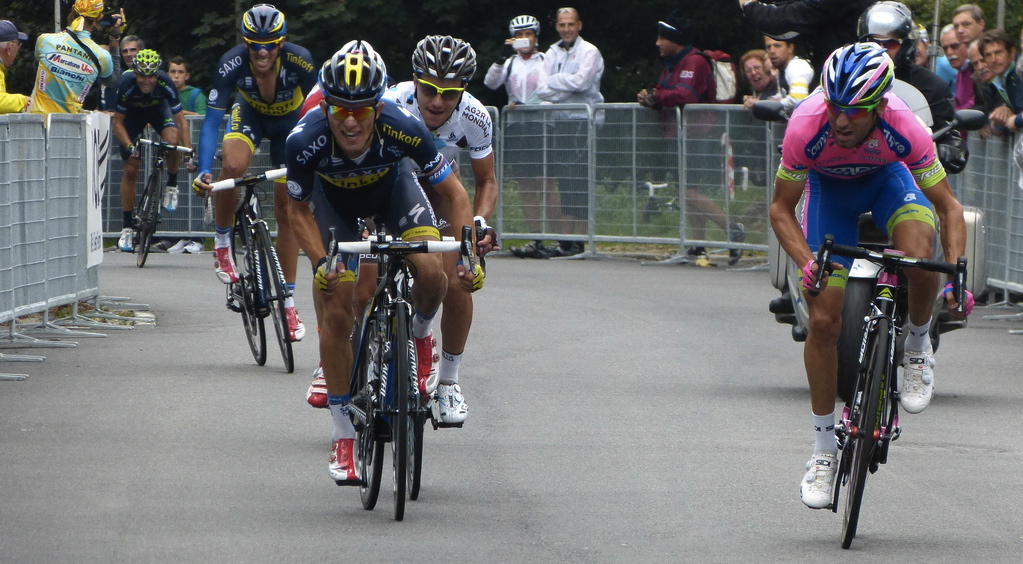
    Ulissi

    Poland showed off a pair of riders with top level ability this year. Nico Roche’s teammate Rafal Majka didn’t win any races, but he was 7th overall in the Giro d’Italia and 2nd to Betancur for the young rider classification in that race, and he followed up with a 4th overall in his home tour to go along with his 1st place in the points classification of that race. The honors kept piling up as the year went on, when he narrowly missed out on a victory in Milano-Torino against another rising star (pictured above) and then stood on the podium in the final Monument of the year in Lombardy. By the same token (eerily), Michal Kwiatkowski may still have yet to win a pro race, but he burst onto the scene this year with a boatload of strong performances. 4th in both Tirreno-Adriatico and Amstel Gold, 5th in La Fleche Wallonne, and a heartbreaking 11th in the Tour de France after fellow up-and-comer Andrew Talansky grabbed the final top 10 spot on the last day of climbing, Majka looks to be a likely candidate for continued climbing success, and Kwiatkowski showed an incredible array of skills and looks poised to stake a claim to best all-rounder in the very near future.

    A significant number of teams saw young climbing talents rising up the ladder this year. Many are Italian. 2011 Giro stage winner Diego Ulissi took a big step forward with successes on both ends of the season, nabbing a top 10 at Paris-Nice early and then a stage win in the Tour de Pologne and a string of semi-classic victories in Italy. So far, most of his quantifiable successes have been on smaller stages, but he performed at a high level in some big races this year (he was lurking in a number of stages in the Vuelta even if he didn’t come away with a win), inspiring a lot of confidence going forward. He’ll be part of an explosive one-two combination with Rui Costa at Lampre in 2014. Astana teammates Fabio Aru and Simone Ponzi look like prime candidates for success next year. Another Italian, Moreno Moser, had several standout performances this year for Cannondale; he disappeared at times when he was expected to bring his success to a bigger stage, but he showed in Strade Bianche and other races in 2013 that he certainly has the ability to turn promise into achievement in 2014.

    Spaniard Jon Izagirre won’t be sweating the dissolution of his former team Euskaltel too much now that he has a new squad in Movistar, and it’s easy to see why they signed him. He nabbed the runner-up honors in the Tour de Pologne with a surprising time trial performance on the last day, and notched top 10s in the Tour Down Under and the one day Grand Prix Cycliste de Montreal as well.
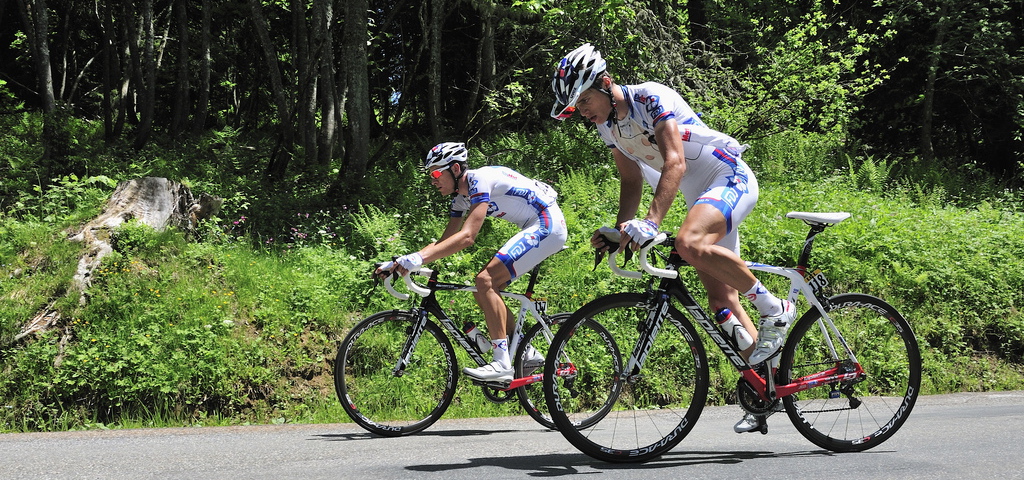
    Vichot

    24 year old Arthur Vichot looks to be one of yet another up-and-comer for FDJ with strong climbing legs and a fast finish, abilities that netted him the French national championship, the runner-up honors in Quebec, and the victory in the Tour du Haut Var-matin. AG2R’s Romain Bardet, winner of the Tour de l’Ain and a high finisher in the Tour of Beijing, appears to have a bright future, and he joins teammate Carlos Betancur as part of a crop of young uphill chargers on that team.

    Wilco Kelderman, a natural time trial talent, came into his own as a climber with a number of high-level successes in 2013. He picked up top 10s in Romandie, the Eneco Tour, and the Tour Down Under, and dominated the Tour of Denmark, where he won a stage, the points classification, and the overall. He’s another exciting up-and-comer for Belkin.

    Argos-Shimano teammates Warren Barguil and Tom Dumoulin got themselves onto the map this year, the former nabbing a pair of breakaway victories in the Vuelta, and the latter claiming runner up honors with an impressive Eneco Tour performance. Alongside Marcel Kittel, Luka Mezgec, and John Degenkolb, the duo makes a potent quartet of Argos riders 25 and under.

    Riccardo Zoidl nabbed the GC win at the Tour of Austria, and climbed at a high level in a number of other events. Darwin Atapuma moves up from Team Colombia to BMC after nabbing his first WorldTour win this year in Poland—that team desperately needs new blood, and Atapuma will be happy to oblige.

    To match all these young climbers coming into their own, a few time trialists are on the rise: Adriano Malori looks to be a threat in that department, putting in a top 10 at the World Championship ITT and taking second place behind Tony Martin on a few time trial stages in WorldTour races to go along with his ITT victory and the overall in Bayern-Rundfahrt. Rohan Dennis out-time-trialed Chris Froome in the Criterium du Dauphine on his way to a top 10 there and then showed his versatility when he won a stage and the overall in the Tour of Alberta. The 23 year old has established himself as a promising member of Garmin’s youth movement.

    This list is by no means exhaustive, and obviously much depends on how you define breakout success, but hopefully I’ve rattled off the names of many of tomorrow’s biggest names. And thanks to the Tour Down Under and its January start date, we won’t have too long to wait for the opening of the 2014 calendar–in just 11 weeks, the pro peloton heads to Nuriootpa, Australia to kick off the new season!

    -Dane Cash

    Photos by Flowizm, brassynn, and Georges Ménager.
  • Vuelta a España 2013 Day 18: Where We Stand After Sixteen Stages, and Looking Ahead to Stages 17-19

    Anton

    Day 18: GC Shaping Up

    The trip to the Pyrenees whittled an already thin list of true contenders down even further. With just three uphill finishes remaining, only three riders are within two and a half minutes of Vincenzo Nibali: Christopher Horner, Alejandro Valverde, and Joaquim Rodriguez. Breakaway riders took impressive victories on Stages 14 (Daniele Ratto), 15 (Alexandre Geniez), and 16 (Warren Barguil again). Attrition dropped Nicolas Roche from his spot near the top (he now sits 3:43 back on Nibali after a trying Stage 14) and it dropped Ivan Basso and many others out of the race entirely on a rainy, cold Stage 15 that saw mass abandons. On Stage 16, as the GC contenders rolled in behind Barguil and Rigoberto Uran (who lost out to Barguil in a photo finish), Nibali looked vulnerable for the first time, losing a little over twenty seconds to his rivals. After the rest day, the road from Calahorra to Burgos provides only on a pair of Cat. 3 climbs, giving Nibali a bit more time to get back any strength he might be missing before the arduous trip from Burgos to the Peña Cabarga, and then the lumpy stage that prefaces the road to l’Angliru.

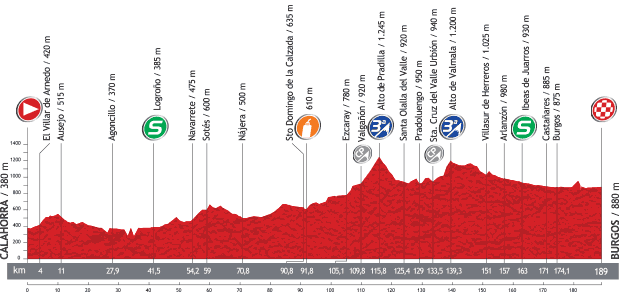
    Stage 17: Calahorra > Burgos | 189km | Medium Mountains

    VS17

    While there are only two categorized climbs, there is a good deal of upward travel in the first 140 kilometers of the stage. The last few days have been for aggressive attackers, and surely Stage 17 will see riders striking out for the long one; but it’s been a long time since the sprinters had a chance to be on camera, and those who have made it this far will fight hard to bring back anyone up the road. The last several kilometers are techinical and include a short but steep spur that will invite further aggression. Michael Matthews and Maximiliano Richeze have looked the strongest to the line so far in this race, if it comes to a bunch sprint. Edvald Boasson Hagen, Gianni Meersman, and Fabian Cancellara are strong options as well, given their combined sprinting and soloing abilities. Boasson Hagen’s Team Sky came so close to a victory in Stage 16, and Eddy Bos himself was barely pipped to the line by Philippe Gilbert earlier in the Vuelta; he’ll be highly motivated and he’s very capable in this sort of finish. Juan Antonio Flecha has been a common sight at the Vuelta’s sprint finishes, though he hasn’t come that close to actually winning anything. This finish suits him as well as any.

    VeloHuman Stage Favorites

    1. Edvald Boasson Hagen | 2. Michael Matthews | 3. Maximiliano Richeze | 4. Fabian Cancellara

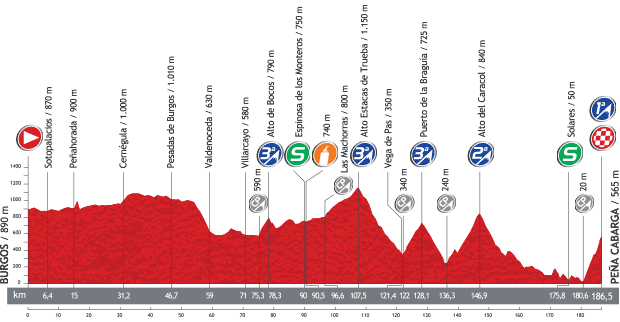
    Stage 18: Burgos > Peña Cabarga | 186km | High Mountains (Summit Finish)

    VS18

    The road out of Burgos is much more demanding than the road in. It goes up and over a trio of Category 3s and a hard Cat. 2, and then finishes atop the Peña Cabarga. The summit has seen fireworks before (future Tour de France winner Chris Froome bested Juan Jose Cobo here in 2011). It’s an extremely difficult, 6 km push at an average of 9.2%, and a 20% section in the final kilometer will surely see gaps form late if they haven’t already. With so many lumps early, this stage could be another for a breakaway, as the GC strongmen haven’t seemed too concerned with the prospect of hunting down early breakers. If that happens, watch out for Rigoberto Uran, who was so close to a victory in Stage 16. Amets Txurruka will probably have another go at it, as might Chris Anker Sorensen. Diego Ulissi has been a bit quiet lately, but after some rest, he might have the strength to challenge for the stage victory. Igor Anton, currently in 15th, will probably be allowed up the road if he attacks on the final climb, and he’s managed to keep pace with the GC heavyweights over the last few days, showing great form.

    Whether their battles will come behind a successful breakaway is hard to say, but the fight among the red jersey contenders will be fierce. Having smelled blood on Stage 16, Nibali’s rivals will look for a chance to test him again here. The steepness would seem to favor Joaquim Rodriguez. Alejandro Valverde looked good attempting to chase him down on the last day in the Pyrenees. Thibaut Pinot has been very impressive of late, and his fresher legs appear to be paying off. Samuel Sanchez has been coming on strong. Chris Horner looks unbelievable going uphill, and he’s had the help of a very strong Robert Kiserlovski. Nicolas Roche cracked on stage 14, but on Stages 15 and 16 he was looking sharp again. The relatively short length of the climb will not favor Nibali’s climbing style, so he’d better be rested and ready to fight.

    VeloHuman Stage Favorites

    1. Joaquim Rodriguez | 2. Igor Anton | 3. Rigoberto Uran | 4. Christopher Horner

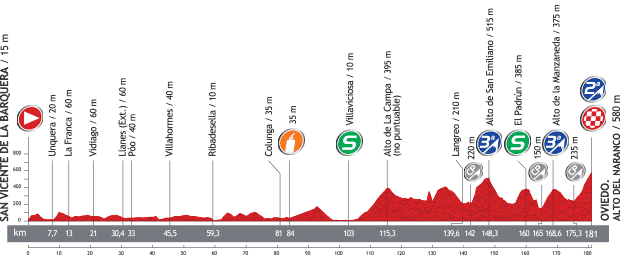
    Stage 19: San Vicente de la Barquera > Alto del Naranco | 181km | Medium Mountains

    VS19

    A relatively flat first half gives way to a very lumpy second half: this stage will favor an aggressive, punchy rider with a lot of pop still in his legs after so many miles already traveled through Spain. The day finishes with a roughly 6 km, 4.2% average grade Cat. 2, Alto del Naranco: not tough enough to open up big time gaps in GC, but more than tough enough to put a hard hitting climber in line for the victory. Warren Barguil has to be in the conversation again. Rinaldo Nocentini has come close in a few stages (2nd to Barguil in Stage 13), and the explosive French rider will look to stand out among a field that has been reduced by the tough hills and tough weather by this late point. Bauke Mollema was right behind him on that stage and will be hoping to salvage something from this Grand Tour, and he is a hard finisher uphill. Uran and Ulissi will again be aiming to put their explosiveness to good use. Uran’s teammate Sergio Henao and Lampre’s Michele Scarponi (who has been very active in breakaways recently) could see an opportunity here, and Amets Txurruka will definitely look to be involved in any breakaway proceedings. Should the peloton reach the final climb together, the Katusha duo of Daniel Moreno and Joaquim Rodriguez will try to best Alejandro Valverde for the day’s victory, and Samuel Sanchez will be gunning for the line as well. Chris Horner has basically attacked on every summit finish, and he could do so again here. Ivan Santaromita, Mikel Landa, and Pieter Serry are other outsiders for the stage win, whether from the breakaway or the peloton.

    VeloHuman Stage Favorites

    1. Rigoberto Uran | 2. Diego Ulissi | 3. Bauke Mollema | 4. Warren Barguil