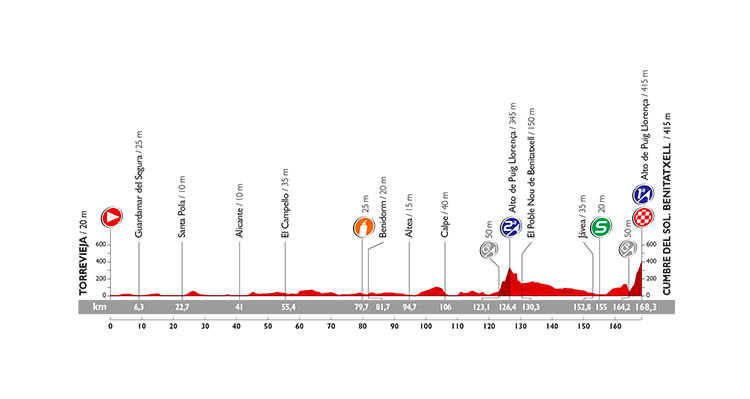
The Vuelta takes on another GC-oriented stage in its ninth day. Most of the relatively short stage is flat, but things get a bit more difficult in the final 50km. A Cat. 2 trip up the Alto de Puig Llorenca comes first, 3.3km at a steep 8.9%. Then comes a steep descent, followed by a more gentle stretch of downhill that extends for over 20km to the intermediate sprint at kilometer 155. Afterward comes a small uncategorized bump, another steep descent, and then the second trip up the Puig Llorenca, from a different side this time. The average gradient is again 8.9%, but it’s a 4.1km journey to the finish line at the top. A particularly brutal stretch of 19% awaits right in the middle of the climb, and the final few hundred meters hit the double digits again.
At just 4.1 kilometers long, the finishing climb is not exactly the Stelvio, but its vicious gradients will make for an explosive challenge. Now that Stage 7 has offered a glimpse of what’s what in this GC showdown, the stronger riders could seize the opportunity to put their rivals into the red zone on the extreme slope.
After a challenging, hot first week, and with an escapee-friendly profile, Stage 9 could appeal to the breakaway specialists. The usual favorites among the GC men haven’t exactly shown a great deal of interest in fighting for stage wins. However, none of the marquee climbers have fallen too far out of contention just yet in this Vuelta, and it will take a pretty strong group to survive if the peloton does ramp up the pace in preparation for the final climb, so it’s hard to see any individual breakaway candidates as top favorites over the heavy hitters in the red jersey battle.
The short but brutally steep climb should suit Joaquim Rodríguez. Based on his skillset, he has to be seen as a favorite. However, Rodríguez has been very conservative so far in the race, and that makes it harder to view him as anything close to a consensus top pick for the stage. He can’t expect to hesitate his way to a stage win, or a Vuelta win for that matter. If he goes on the move, he’ll be deadly. The same is true for Katusha teammate Daniel Moreno.
Fabio Aru was the strongest rider on Stage 7, opening up a significant gap on his rivals when he launched his move on the final climb. Unlike Rodríguez, he took risks on that stage, and he might be looking to do so again here. This climb doesn’t suit him all that well compared to a few of the extremely explosive climbers on the startlist, but I think he’s strong enough to win anyway. Mikel Landa makes for a fine alternative for Astana.
Esteban Chaves has shown already in this Vuelta that this sort of climb suits him well. Getting into the second week of the race, Chaves is entering unknown territory, but he hasn’t shown signs of slowing down yet, and he could find himself in the mix again on Stage 9.
Alejandro Valverde has looked strong so far in the Vuelta, but maybe not at peak form. He also isn’t particularly keen on jumping clear of the pack, which he’ll probably need to do to win this stage. Still he’s always a danger, as is Nairo Quintana, who could light up this race at any minute once he starts getting back to his best.
Domenico Pozzovivo should find the terrain to his liking, and after a slow start he looks to be getting stronger. Unlike most of the other red jersey hopefuls, Pozzovivo doesn’t have a Grand Tour in his legs, and could find himself feeling a lot fresher than his rivals. He also might get a bit of leeway if he goes on the attack, as the likes of Movistar and Katusha look at each other instead of anyone else.
Nicolas Roche will find this gradient extreme, but he has looked good so far, as has Sky teammate Mikel Nieve. I’m not ready to write Chris Froome off yet either, though I still probably won’t write him off even if he loses ground on this stage, for that matter, as I think he’s riding himself back into form at the moment.
Rafal Majka, Samuel Sánchez, and Louis Meintjes are others to watch on the final climb.
If the GC favorites don’t feel like putting their teams to work chasing down escapees, Pello Bilbao, Rodolfo Torres, Fabio Duarte, Gianluca Brambilla, Alessandro De Marchi, Bart De Clercq, Daniel Navarro, and Cyril Gautier are among the many riders who could find success in the early break or with a late strike.
Be sure to follow @VeloHuman on Twitter for more analysis and commentary during the race, and check back for the preview of the next stage after the conclusion of Stage 9. The VeloHuman overall Vuelta a España race preview is available here. Also, don’t miss the latest Recon Ride, which covers all the big storylines ahead of Sunday GP Ouest-France.
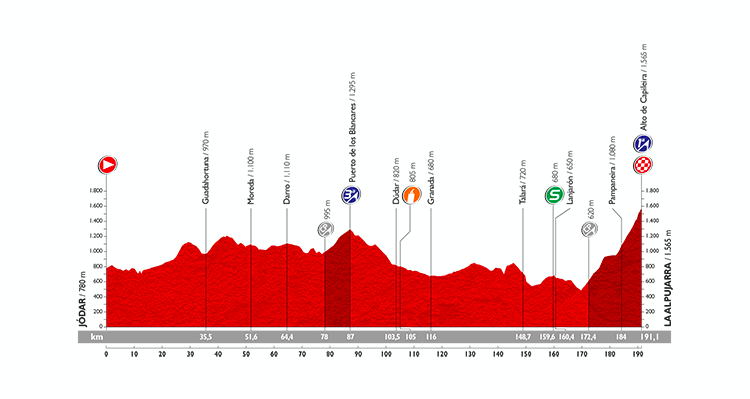
The first Cat. 1 summit finish of the 2015 Vuelta awaits on Stage 7. Like Thursday’s stage to Cazorla, Friday’s stage will put the peloton through another long day of rolling hills, but the finishing climb on Stage 7 is considerably more challenging.
For the first 170 kilometers of the day, the road takes on successive stretches of gradual climbs and gradual descents, with a single 9km Cat. 3 the most challenging of the many minor climb along the route. The final 20 kilometers of the stage, however, will offer a real test of uphill strength.
At around kilometer 170, the route angles upwards towards the official start of the Cat. 1 summit finish, the 18.7km Alto Capileira. The climb has an average gradient of 5%, but that doesn’t really tell the full story. The first 6 kilometers are a bit steeper than that average, and then the road flattens out for about 4km, and then it kicks up again for the rest of the way to the line. The final 9km angle upward at closer to 7%, with a particularly steep section near the finish of about 14%.
The Alto de Capileira will be hard enough to put the GC favorites to the test, with the irregular nature of the climb adding to the difficulty. Whether or not the red jersey hopefuls will be doing battle for the stage win as well as for positions on the overall leaderboard is another matter—the profile will be an appealing one for the breakaway. However, it will take a talented group to stay clear on such a tough day, and most of the top climbers in the Vuelta are still in relatively close GC contention, limiting the number of legitimate candidates for long-range success. I like the chances of the GC riders this early in the race.
Movistar’s two-pronged attack won’t be easy for anyone to counter. Alejandro Valverde has not been particularly aggressive so far in this race, relying on his fast finish to take his stage victory, but he has nevertheless looked strong. He knows the area, he is very motivated to build on his early advantage in the GC battle, and he can win with an attack or in a reduced sprint at the top of the climb if there is no separation at the line. Nairo Quintana may be more of a foil than anything right now. Obviously the two-time Tour de France runner-up is a major threat to win any stage with this sort of finish, but he has looked slightly less than 100% at this point in the race, and in the heat of southern Spain. He’s a danger, but more than anything his presence may boost Valverde’s chances.
A week ago I saw Fabio Aru as the favorite for Stage 7, but now I’m not sure how to judge his chances. He should be fresher than the rest of the top GC contenders in the Vuelta who are coming off the Tour de France, he showed nice form in the Tour of Poland, and this stage suits him perfectly, with a nice late launching pad that looks tailored to his skillset. However, he hasn’t looked quite as strong as expected so far in this race, so I can’t quite name him the outright favorite. Still, he’s an obvious candidate for success and it wouldn’t be any surprise if he attacked for the win. Mikel Landa could do damage as well on this climb.
Joaquim Rodríguez is another rider whose form is hard to judge right now—he has missed out on several opportunities so far in this Vuelta, letting others making successful attacks on stages that have seemed to suit him. But that may simply be because Rodríguez is focused entirely on the overall title, unwilling to risk his GC position in the hunt for stage wins. This stage certainly suits him. Daniel Moreno is another option for Katusha.
Chris Froome has quietly ridden very well in the early goings at the Vuelta. For whatever reason, many observers underrate Froome’s peak climbing ability, and I think some are underestimating him here. He’s not at his peak, of course, but if he’s even close to it he’s capable of leaving the entire peloton in the dust. Froome loves to make an early statement, and this is a prime opportunity to do just that on a long climb that suits him well. Nicolas Roche and Sergio Henao are other strong options for Sky.
Esteban Chaves has been brilliant so far in this Vuelta, and while both of his stage victories have involved an element of tactical boneheadedness from the likes of Katusha and Co., they wouldn’t have happened if Chaves weren’t on blazing form. This is a very long climb for the young Colombian to undertake but the likes of Valverde and Rodríguez have shown little interest in chasing him so far and that could be to his advantage yet again if he can survive the long road to the top and make a late strike.
Domenico Pozzovivo, Tejay van Garderen, Dan Martin, and Rafal Majka are others who could be in the mix for Stage 7.
As suggested for Stage 6, keep an eye on Caja Rural and Team Colombia for the likely breakaway contenders on Stage 7. It will be a tall order to hold off the pack on the Alto Capileira, but Pello Bilbao and Fabio Duarte are among those with a shot. Pierre Rolland, Joe Dombrowski, and Samuel Sánchez are other riders who could have success with a long-range strike.
VeloHuman Stage 7 Favorites
1. Alejandro Valverde | 2. Chris Froome | 3. Fabio Aru
Be sure to follow @VeloHuman on Twitter for more analysis and commentary during the race, and check back for the preview of the next stage after the conclusion of Stage 7. The VeloHuman overall Vuelta a España race preview is available here.
The youngest of the trio of legendary three-week races, the Vuelta a España tends to garner less attention than the Giro d’Italia or the Tour de France, but the past few editions of Spain’s biggest race have been must-watch cycling entertainment. The challenging route, the top-notch startlist, and the desperation for results always present at this part of the season should make for an epic final grand tour of 2015 (the perfect storm of factors likely contributing a thrilling Vuelta is just one of many topics covered in the Recon Ride’s Vuelta pre-race show by the way—you should definitely check it out).
The Route
This year’s Vuelta offers the variety of profiles to favor a well-rounded winner. After things open with a very short team time trial (short enough that it’s unlikely to make a difference for the GC battle), the race takes on an uphill finish (albeit only a Cat. 3) right away in Stage 2, which is a great way to set the tone for a challenging race.
Then come several days that look likely to favor the sprinters or puncheurs, until a likely GC showdown on Stage 7, which sees the first Cat. 1 finishing climb of the race. After a medium-difficulty day on Stage 8, the Vuelta will throw another Cat. 1 uphill finish at the pack on Stage 9. Then, it’s a stagehunter friendly Stage 10 and a long-awaited rest day after a whopping ten straight days of racing.
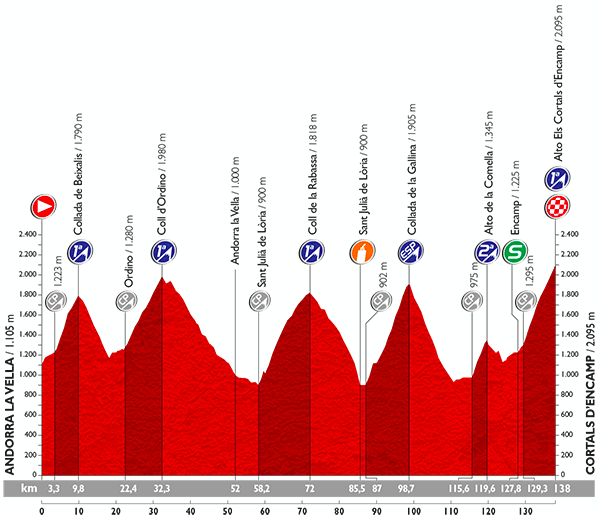
Any dreams of a stress-free return to racing after the day off will be squashed by the brutal Stage 11, which will throw one steep climb after another at the riders
Stage 11: Andorra la Vella › Cortals d´Encamp (138km) – The peloton will come back from the first rest day of the Vuelta to face a tough day in Andorra.
After such a difficult Stage 11, pair of more fast-finisher-friendly stages will give the GC men a chance to relax a bit, but climb-heavy Stages 14, 15, and especially 16 will bring them to the fore again.
The Stage 17 time trial will also be a critical day for the GC hopefuls.
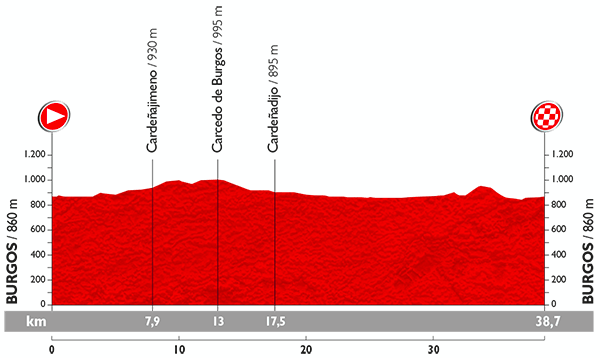
Stage 17: Burgos › Burgos (38.7km) – A time trial favoring the big engines in the Vuelta’s final week will put the pure climbers under pressure.
A little under 40km and mostly flat, the ITT could deal a serious blow the GC campaign of anyone without strong time trialing ability.
Stages 18 and 19 look good for those with an aggressive streak who are not afraid to be active on the late climbs, before a Stage 20 that consists of four Cat. 1 ascents.
To close out the race, the sprinters will get one last chance on the final stage in and around Madrid.
The General Classification Contenders
Most of cycling’s top Grand Tour GC stars are making the Vuelta start this year, which should set up a thriller of an overall battle. Chris Froome, the 2015 yellow jersey winner himself, headlines the startlist. It’s pretty rare for a Tour winner to start the Vuelta, but Froome has come close here in the past and has some unfinished business to take care of.
It’s hard to say just how well the route suits him because the Chris Froome of 2015 is a different rider from the Chris Froome that won the 2013 Tour de France. That previous incarnation of Froome was an excellent time trialist who could take advantage of a long flat ITT against less chrono-savvy rivals. The Froome of the past two years, however, has been far less impressive against the clock. If Froome can get his time trial back on track, he could run away with this race. If he doesn’t, this will be a close fight, though Froome is still among the world’s very best climbers (something that often gets overlooked or underplayed by many observers) and can still win this race on pure climbing ability and a powerful team. Geraint Thomas and Nicolas Roche are back at Froome’s side. Sergio Henao could be the real star—he’s been prepping for this all season and he’s been sharp recently. He makes a fine alternative if Froome decides a few days into the Vuelta that he’s content with his Tour de France win and doesn’t need to fight for a second Grand Tour in 2015.
Nairo Quintana and Alejandro Valverde were unable to wrest control of the Tour de France from Sky but they’ll have another opportunity here. The time trial won’t help the Movistar pair, but motivation to beat Froome will be pretty high, and a route filled with steep climbs will offer plenty of chances to launch a flurry of attacks to keep the pressure on. Quintana is the better overall rider at this point and if his motivation is there he could challenge for the win with help from Valverde. If Quintana isn’t coming in at 100%, Valverde will likely be in the mix on his own, though winning the Vuelta against this caliber of rivals would be a tall order. Andrey Amador is another card to play on a strong Movistar squad.
In terms of depth, Astana’s trio of Fabio Aru, Mikel Landa, and VincenzoNibali headline the strongest GC squad in recent memory. Aru is probably the team’s best hope, having been preparing for this race since his runner-up performance in the Giro. He’ll love all the opportunities to break clear of his rivals on the tough climbs of the race, and he’ll probably be a bit fresher with more of a time cushion since his last Grand Tour appearance than those who raced the Tour. Meanwhile, Nibali will be motivated to prove something in this race after a disappointing Tour de France. He’s not afraid to get aggressive and if he is in better shape for this race, he’ll be up there. Landa is the wildcard—he has said he is targeting stages, and a long flat time trial does not suit him in the slightest, but he showed flashes of incredible climbing ability in the Giro and Astana’s multifaceted approach could see him steal a huge chunk of time if he can launch an unanswered move somewhere along the way. It would be pretty surprising if Astana didn’t land at least one rider on the Vuelta podium.
Joaquim Rodríguez will have his work cut out for him taking on such a list of stars in this Vuelta, but he did not have to expend nearly as much energy in the Tour as his other Vuelta GC rivals—his stagehunting focus allowed him to take days off in the mountains. Daniel Moreno will serve as a valuable second.
Rafal Majka leads the Tinkoff-Saxo charge. He should put in a good Vuelta campaign—he has developed into a well-rounded rider who isn’t afraid of a time trial, and like Rodríguez he should be a bit fresher than Froome or Quintana.
Speaking of freshness, Domenico Pozzovivo probably stands the best chance of being the rider to keep one recent Vuelta streak alive: since 2011, the winner of the Vuelta a España has been a rider who did not complete either the Tour of the Giro earlier in the season. Freshness has been critical in recent years at the Vuelta, and Pozzovivo, who crashed out of the Giro early, has not put the same sort of wear and tear into his legs this season as many other ridres in this race. He’s also a specialist on the steep stuff, which the Vuelta has in spades. Expect a strong ride from Pozzovivo here.
BMC’s Tejay van Garderen will find himself in the same boat, hoping to benefit from the freshness of not having finished a Grand Tour yet this season, but it’s hard to say how he’ll fair. On the one hand, the Vuelta suits him more than the Tour did thanks to its long and flat time trial, where he is stronger than most of the top GC riders in this race. On the other hand, van Garderen’s Vuelta was a last minute decision to salvage something from the season after his disappointing Tour. If van Garderen is in shape and motivated, I’d expect to see him in the thick of the GC battle. If not, he’ll probably be out of it very quickly. Samuel Sánchez is a fine alternative for BMC, having put up plenty of strong Vuelta rides in the past.
Lotto-Soudal’s Jurgen Van Den Broeck has managed to put up several excellent time trial performances so far this season, and if he can bring that balanced approach into the Vuelta, he could prove to be a big surprise. Cannondale-Garmin’s duo of Andrew Talansky and Dan Martin should be capable of producing at least one contender for the Top 10 among them. Cofidis’s Daniel Navarro hasn’t done much this season but he tends to come alive in the Vuelta. Pierre Rolland rode a respectable Tour de France, nearly coming away with a stage win, and should be capable of another decent result here.
The Stagehunters
Without many pan-flat stages but plenty of days to suit the more versatile fast finishers, it’s no surprise that the Vuelta has drawn several riders who thrive in bunch kicks after harder days. Peter Sagan is an obvious member of that club, though his Vuelta form is a big question mark—last year he rode the Vuelta purely to prep for Worlds, and mostly stayed under the radar. John Degenkolb also makes the start, hopefully with the same interest he showed last year (when he won four stages and the Points Classification) and not an approach entirely centered on his own Worlds campaign. Nacer Bouhanni can handle a climb or two and should be able to nab multiple wins if the form is there for this race—the motivation should certainly be there near the end of a disappointing season. Caleb Ewan, JJ Rojas, Matteo Pelucchi, and Danny Van Poppel are other speedsters to keep an eye on at the Vuelta.
Tom Dumoulin and Fabian Cancellara are obvious favorites for the long, flat time trial in the third week. Simon Gerrans, Alessandro De Marchi, Sylvain Chavanel, Carlos Barbero and Pello Bilbao will be among the riders hoping to do some damage on the intermediate stages, while the likes of Fabio Duarte, Amets Txurruka, and Joe Dombrowski could be on the hunt for breakaway wins in the high mountains.
VeloHuman Top 10 Overall Favorites
GC Winner: Chris Froome Podium: Fabio Aru, Nairo Quintana Other Top Contenders: Alejandro Valverde, Joaquim Rodríguez, Vincenzo Nibali, Domenico Pozzovivo, Mikel Landa, Tejay van Garderen, Rafal Majka
VeloHuman will be previewing every individual stage of the race, so stay tuned for more analysis. Meanwhile, if you haven’t already checked out the Recon Ride’s first of three Vuelta episodes, there’s no time like the present to start listening! And, of course, be sure to follow @VeloHuman on Twitter for more commentary.
Episode 23: Vuelta a España 2015 Show, Part I The Recon Ride dives into the challenging parcours and the excellent startlist of the 2015 Vuelta a España.
[powerpress]
The final Grand Tour of 2015 is about to get underway, and the collection of talents preparing to make the start in Spain is impressive. Cosmo Catalano of Cyclocosm and Dane Cash of VeloHuman team up to present the first of three Recon Ride Vuelta episodes.
The Giro peloton took a rest day after a challenging Stage 15 won by Mikel Landa, but things will get hectic again immediately on Stage 16. The riders will take on the first of five categorized climbs right from the startline. There is practically not a single meter of flat on this stage. After the opening Cat. 2, the riders will take on a fast descent and then another Cat. 2, and then a very long descent into a Cat. 3, roughly the midpoint of the stage. From there it’s another descent into the foot of the brutal Cat. 1 Passo del Mortirolo climb. 11.8 km at a 10.9% average gradient, it’s an extremely steep road to the top, one that will likely see the stronger riders putting on the pressure and blowing the peloton to pieces.
Over the top of the Mortirolo, the riders will take on another long descent into the foot of a Cat. 3 climb to the finish line. It’s long at 14km but not particularly steep with a 3.5% average gradient.
Five categorized ascents on the parcours will make Stage 16 a major target for the Giro’s blue jersey hopefuls. The fact that the climbing starts right away will benefit the uphill specialists trying to get up the road. With the constant up and down likely to hinder any organized chase efforts, this will be a great opportunity for the breakaway riders, though regardless of who is in the lead group, it should provide an opportunity for the GC riders to battle it out as well.
The Mortirolo will offer opportunities to attack but it’s still a very long way to go from the top. With the low gradient on the final climb, a small group could come to the line together, whether it’s a small group of breakaway riders or a small group of survivors from the pack. Carlos Betancur has plenty of incentive to get into the breakaway on this stage in pursuit of KOM Points, and he’s shown an ability to get up the road so far in this race. He has a very fast finish, and if he’s in the lead group at the end of the day, he’ll be very dangerous on this stage.
Beñat Intxausti will of course be looking to get into the breakaway in defense of his KOM jersey. He’s not as fast at the line as others, but he’s got a powerful engine and might be able to ride others off his wheel in pursuit of this stage win. Movistar teammate Giovanni Visconti, on the other hand, does have a bit of pop for a fast finish, and could be in the mix if he’s allowed up the road (nearly 10 minutes down on GC), as might Igor Anton and Ion Izagirre.
Ryder Hesjedal should like the look of the profile and his chances from the breakaway. If he can get up the road, he’ll have a nice chance at victory in Stage 16.
Stefano Pirazzi, Steven Kruijswijk, Esteban Chaves, Ilnur Zakarin, Franco Pellizotti, Sebastien Reichenbach, Mikel Nieve, Vasil Kiryienka, Darwin Atapuma, Jan Polanc, and Damiano Cunego are others on the list of strong candidates for long-range success here.
If this comes down to a select group of GC favorites instead of the long-range attackers, this could come down to the fastest finishers still surviving among the all-rounders. Damiano Caruso packs a bit of punch, as does Fabio Aru, who would probably like to pick up more stage wins in the race even if he can’t beat Alberto Contador for the pink jersey. Caruso will have the added benefit of probably getting some leeway to go up the road late in the race if he sees an opportunity, as he’s far enough out of GC contention to not threaten Contador’s pink jersey. Speaking of Contador, he obviously can’t be counted out on a stage with a climb as challenging as the Mortirolo, even if it does come so far from the finish.
VeloHuman Stage 16 Favorites
1. Carlos Betancur | 2. Giovanni Visconti | 3. Fabio Aru
Be sure to follow @VeloHuman on Twitter for more race analysis, and check back after the conclusion of Stage 16 for the preview of the next stage. Also, don’t miss the most recent episode of the Recon Ride podcast!
After Diego Ulissi’s second victory for Lampre-Merida in three days, the peloton will take on the first Cat. 1 climb of the Giro d’Italia in Stage 8.
The 186km journey from Fiuggi to Campitello Matese involves a whole lot of up-and-down, though only two of the climbs are categorized. From the start there are a few rollers leading into the Cat. 2 Forca d’Acero, which is extremely long for an ascent of that rating: 26km long and with a 5% gradient, it will most certainly wear down even the most adept climbers. From there the road takes a generally downward path, interrupted by a few upward stretches of not-insignificant length, toward the town of Isernia. Then it’s another mid-size uncategorized climb before the challenging final test to Campitello Matese. 13km at 6.9%, it’s not an awful road to the top but it won’t be comfortable for anyone after so many climbs on the day.
The profile should be pretty enticing for the breakaway, what with the constant up-and-down, and it will be very difficult for the pack to keep the break on a tight leash. Then again, the GC riders will almost certainly want to put the pressure on each other to try to open up the leaderboard at the top a bit, which could make it hard for those up the road to stay out front. What’s more, the upcoming Stage 9 looks even more perfect for the breakaway, and it offers an extra KOM opportunity, so those in pursuit of the blue jersey may be content to wait. It seems like a 50-50 proposition as to whether this one goes to the bunch or a morning breakaway.
Among the GC contenders in the bunch, Fabio Aru should be the favorite for success here. He has the most incentive to get separation on these mountain stages given his time trial skills, which are weaker than those of Alberto Contador and Richie Porte. He’s also looked sharp so far, and he has a powerful team around him. Mikel Landa’s GC position makes for a great asset to the team—Astana could send him up the road in pursuit of the stage win as well.
Alberto Contador also looks strong, but it remains to be seen how well he’ll cope with the challenges of the day. He looked okay on Stage 7 but this is a bigger test. With an almost guaranteed breakaway to come followed by a rest day and then a sprinters’ stage, he may try to take this easy. Teammate Roman Kreuziger is also high up on GC, and could be given a green light to go stagehunting here if he’s feeling good.
Richie Porte is the other obvious candidate. He’s climbed so well this early in this season that he’s got to be among the top favorites again here. The climbing on the day suits him quite well. Expect Porte to be aggressive trying to put his stamp on the race.
Esteban Chaves may get some leeway if he goes on the attack, and he’s looked good, if not fantastic, so far in the race. The same goes for Damiano Caruso and Darwin Atapuma; both are within 2 minutes on GC and strong enough climbers that it’s hard to tell whether the bunch would let them get clear or not, but if they do they’ll be dangerous—Atapuma in particular has looked great on the climbs this year.
Giovanni Visconti is amazingly within 1 minute of the Giro d’Italia race lead. He shouldn’t be a threat to the pink jersey in Milan, so despite his high position at the moment, he may be given the opportunity to go from afar—if he does, watch out, as he looks quite strong right now.
Stefano Pirazzi is no GC threat at all and he’s been aggressive, if not particularly successful, so far in this race. There are mountain points on offer here and a chance for Pirazzi to make his mark—I do wonder, though, whether he may want to keep his powder for the perfect breakaway day that awaits on Sunday instead, especially if other purer climbers manage to get into the Stage 8 early move. Edoardo Zardini and Francesco Bongiorno are other options for Bardiani-CSF. Lampre’s Przemyslaw Niemiec looks okay so far in the race but he’s down on GC after a poor opening TTT and then getting caught out in the crash-filled Stage 2 finale. He could try to go for one here. Ryder Hesjedal might as well; alternatively his teammate Tom Danielson has been very strong in the breakaways all year, winning the KOM jersey at the Volta a Catalunya, and this could be a nice opportunity for him.
Franco Pellizotti, Carlos Betancur, Igor Anton, Ilnur Zakarin, Ion Izagirre, and Beñat Intxausti are others on the very long list of potential long-range victory candidates.
VeloHuman Stage 8 Favorites
1. Fabio Aru | 2. Richie Porte | 3. Darwin Atapuma
Be sure to follow @VeloHuman on Twitter for more race analysis, and remember to check back after the conclusion of Stage 8 for the preview of the next stage.