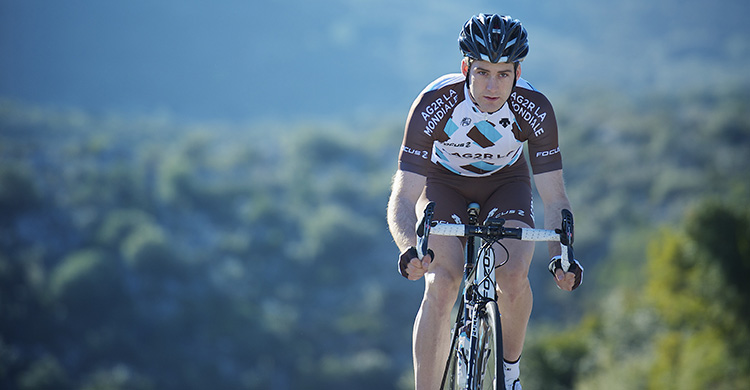
In a new entry in the Up-and-comer Q&A Series, VeloHuman talked with 23-year-old Hugo Houle, a native of Sainte-Perpétue, Quebec. With the Tour of Alberta underway and the Grand Prix Cycliste de Québec and Grand Prix Cycliste de Montréal around the corner, now is the perfect time to catch up with one of Canada’s fastest-rising young stars.
In his second year with French team AG2R La Mondiale, Hugo Houle is an all-round talent who made a name for himself at a young age, winning Canada’s Under-23 road race and time trial championships and finishing 4th overall in the U23 World Championship road race. His big results garnered the attention of WorldTour team AG2R La Mondiale, where he signed at the end of 2012 and has been riding since, with a largely classics-oriented race calendar. He recently spoke to VeloHuman about his year so far and his expectations for the rest of the season.
VH: Hugo, you joined AG2R La Mondiale last year after spending a few years with Pro Continental Squad Spidertech. What was it like at first making that jump from Pro Continental Team up to the WorldTour? How did that transition go compared to your expectations?
HH: In the end, it was the folding of Spidertech that gave me shot to join AG2R La Mondiale, because at first I had two more years with Spidertech. They folded at the end of 2012, so I found a place at AG2R La Mondiale, and I’m going to ride for them until 2015; I still have one more year on my contract with them. It’s a big step, because when you join a WorldTour Team, the races are longer and they make you ride more races. Sometimes you do two or three stage races in one month, so it takes time to build up to the volume of races. Also, the culture of a French team was new so I had to make some adjustments with that. So those are the big differences. With the volume of racing and the races being longer, you need to train longer, so I had to step up my training.
VH: You rode plenty of races in your first season, with particular focus on the classics. What would you say were the biggest things that you learned in your first year?
HH: I learned a lot! The first thing: to get to know a course, like, say, in Belgium . . . it’s hard, so it takes a couple of years to get to know the cobbled sectors and how to approach them and place yourself. So that’s the main thing. Even if you are strong, if you’re not well-placed, you don’t finish in the front, so last year I was more trying to understand the cobbled sectors. Now I’m good and I know them, so it’s easier to be well-placed, with good timing, and know when I have to move up. So that’s one thing. And also learning how to race with the team, the teamwork, and all that stuff. To know a teammate, what they like and what they want me to do, because I’m still pretty young so I have to do a lot of work and understand the races and do the best I can to help them save energy to be there at the end.
VH: You look to be getting more comfortable in your second season, both in longer races and on the cobbles: last year you started Milano-Sanremo and Paris-Roubaix, but this year you started and finished them. Do you feel that you have continued to develop this year?
HH: Yeah, for sure. Like I said, in those big races I now have more endurance so I can hold on for longer. So it’s easier to finish a race because I’ve become used to that distance and I know how to be well-placed. . . . So for sure it’s easier in the second year. . . . It’s not easy but I’ve learned a lot and I progress every year so that’s a good thing and the team is happy with the work I do.
VH: Does AG2R La Mondiale have a specific role that they’re hoping you’ll grow into, maybe for the classics, or as a time trialist, etc.? You have a pretty versatile skillset.
HH: For now they want me to do the work more than do my own stuff, but I have a good time trial and when I have an opportunity to do good on that, I always go all out. But they always put me in the big races, so to get the wins it’s hard because I’m still young. I do most of the classics, that’s where they want me to do well and support other riders, but they’re not talking about a leadership role, it’s more a support role for now. But I’m more of a punchy rider, so when it’s hills, circuit races like Quebec and Montreal, that’s where I could be good.
VH: Are there any particular aspects of your skillset that you’ve worked to improve this season?
HH: Yeah, they want me to lose some weight and be better in the hills. But it also depends on the time of year, because I’m doing classics the beginning of the year, and there we need more power for flat sections . . . and then for the second half of the year you need to be climbing, because I do more stage races, like Wallonie, Pologne, and now Limousin. It’s more hills, so I work more on those and am careful for weight because it makes a huge difference, the ratio of power to weight. . . . And before nationals I was doing more time trials. So I just try to see which races I’m going to do and try to train to be ready for that kind of effort. Let’s say if I do Montreal/Quebec, I try to do three to five minute hills to get ready for that kind of effort when I arrive at the race, so that I’m ready to do that. So all year, it changes.
VH: Speaking of nationals: you’ve won both the Canadian U23 time trial and road race championships in the past, and you put in good performances this year at the top level with a 2nd place in the ITT and 7th in the road race. Is representing Canada on the international stage important to you?
HH: Yeah, for sure. It’s important to try to build up the sport more in Canada. The sport is doing well, a lot of people are cycling and getting more interested in it. In Quebec they show more races now, all the classics and the three Grand Tours. Before it was only the Tour de France, so that’s a good development. For me, to be an ambassador for that is important, and to work with national teams and do well at nationals, that’s important for me. Racing in Europe, you bring a lot of experience that you can share with other riders. . . . I was pretty lucky to have Spidertech to make me race in Europe, and I was able to have a good result at the World Championship. That’s what helped me make the jump to a WorldTour team. The hardest thing is to get to a team. After, if you do well, your job and everything else, they keep you on board and you make friends with people. But the hardest part is to make a team in Europe and that’s why it’s hard for Canadians. So if I can help with that, it’s always good, and it’s nice to have more Canadians in the pro field. It’s important to do well and represent the country and get other riders to come to our level and come race with us.
VH: Do you think a Canadian champs jersey, either for the time trial or the road race, might be a possibility in your future?
HH: Yeah, that would be a goal. Right now it’s hard in the time trial with Svein Tuft, he’s pretty good at it! But I’m still young and have a couple of years ahead of me, so one day it could happen if I work hard and it’s something I would love to do. To wear the jersey in Europe for a whole year is something special and it gives you good visibility so it’s really important. I hope to do the double, like I did in U23, in the coming years. It would be great, but it’s always hard; Nationals, it’s always a special race because everyone knows the WorldTour guys are stronger and they all look at us to make the race and chase, so it’s always strange, but for time trial, I’ll keep training hard on that and one day maybe I’ll be as strong as Svein Tuft.
VH: Well he is 37, so you have to think that at some point, maybe . . .
HH: Yeah. I’m still 23 so I’ve still got a couple of years ahead of me!
VH: What are your goals for the rest of the season?
HH: I’d like to put in a result at the Tour of Alberta. It’s a good opportunity for me to race for the national team and I’m going to be a team leader and can do what I want to do, so I hope I can make a result there, and then a great performance in Montréal and Québec would be great for the people there and in front of my family, so I hope for a good result.
VH: Last question, looking into the future a bit. Is there one particular race that maybe you grew up watching or maybe that you’ve ridden now and enjoyed that stands out as one you’re hoping to target for success in your career?
HH: I think a lot of the races that I wanted to do, one-day races, I’ve done almost all of them, but now I will try to go for a Grand Tour for next year. Maybe the Giro or the Vuelta, though the Tour de France will be hard. The goal would be to ride the Tour de France before I stop cycling. I was not thinking about it when I started cycling, because it was just for fun, but now in the past few years I’ve seen that become more realistic. So to finish the Tour de France would be a big accomplishment, and racing the Olympics would be good also, so that’s the next step for me and that’s where I want to go.
Still a few weeks shy of 24, Hugo’s role as a developing rider gaining experience particularly in the one-day races puts him in an interesting position on a team hoping to expand its results beyond the steep mountains, where they have had so much success this year. At the moment, Hugo is focused on landing results in Canada’s collection of major late-summer events, where profiles heavy on the short climbs suit his skillset nicely.
-Dane Cash
Photo by Kramon.
