Tag: Leopold Konig

  • Leopold König on Overcoming Injury, Tour de France Success, and What’s Next in 2014

    Leopold König on Overcoming Injury, Tour de France Success, and What’s Next in 2014

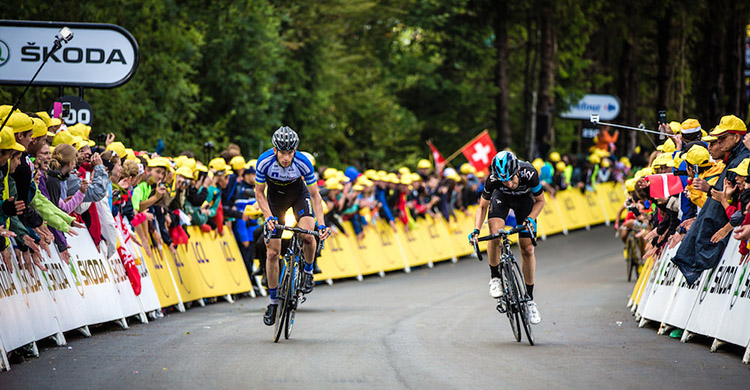
    Konig Climbing

    Given his 7th overall finish in this year’s Tour de France, you might think it’s been smooth-sailing all year for NetApp-Endura’s Leopold König, but almost from day one this season, things have not exactly gone according to plan for the rising Czech star. Having battled through a knee injury early in the year and a tough bout with illness more recently, 26-year-old König is now stateside to participate in the USA Pro Challenge, and he battled spotty reception in the Colorado mountains (much to the gratitude of VeloHuman) to answer a few questions about his fight to overcome one obstacle after another on his way to some fantastic results on the sport’s biggest stage, and what lies ahead for the rest of the year.

    König closed out his 2013 season on a high note, notching a stage win and 9th overall at the Vuelta a España, delivering the kind of performance for Pro Continental squad NetApp-Endura that announced to everyone just how deserving they were of a wildcard invitation. With an invite to ride in the Tour de France in 2014, it was fairly obvious what NetApp-Endura’s plan would be: build a team around this fast-rising talent to support his GC ambitions and again prove themselves worthy of their wildcard invite.

    With the sport’s main event on the horizon, König set out to build his form over the early months to be at his best for the big race in July, but just as the season began, his plans were derailed by a nagging knee injury.

    “Ligament issues,” he told VeloHuman. “It wasn’t too serious but the problem was the healing process lasted so long, and the only way to fix it was to relax the knee and not put any pressure on it. So that was very frustrating because we didn’t know how long it would last and finally it was more than one month, it was actually a long time.”

    Any plans to target a particular aspect of his skillset for improvement in training went out the window.

    “To be honest, there wasn’t much time to get specific training in, and we had to adjust a lot of training because I was one month off the bike and it was just a race with time to get to the Tour in time and to get prepared,” he said. “I actually just did one real training block in the Sierra Nevada that was more focused on climbing, and then I went to Bayern and the Dauphiné. So there wasn’t really much time to get specific training in for the Tour.”

    As might be expected, not being able to prepare for the biggest goal of his career was not easy for König.

    “I tried to stay relaxed and not really think about it but it was pretty hard to manage mentally because, as I mentioned, we didn’t know when I would be able to train properly, or when I would be able to race,” he explained. “I tried to stay relaxed but there were moments when it wasn’t really easy. But finally it worked out.”

    At last on his way back to recovery (he finished 4th at the Bayern Rundfahrt and 11th at the Critérium du Dauphiné), König took on his very first Tour de France with the added expectations that come with being a team leader.

    “Everything was much bigger, all the pressure, the media attention, and the things around are just bigger than the Giro and Vuelta, but we went into the Tour with a strong team and we wanted to prove to the organizers that the wildcard we got was worth it,” he said.

    König’s Tour campaign itself got off to a rocky start. He lost more time than many of his GC rivals on the cobbles and then crashed hard on Stage 8, losing several minutes. At the end of Stage 9 he was already more than nine minutes off the lead and sitting in 28th place. However, from then on he put in one great ride after another (including a 3rd place performance on Stage 13), climbing higher and higher up the GC leaderboard as the Tour became more mountainous. König attributes his strong second half to his endurance and his ability to get into a groove.

    “I think that’s just the way my body is built,” he said. “I’ve done just 2 Grand Tours but I can feel that every week I’m improving and feeling better. The first ten days of the Tour were especially hard and unlucky for me but then I just started to feel day by day more relaxed and powerful.”
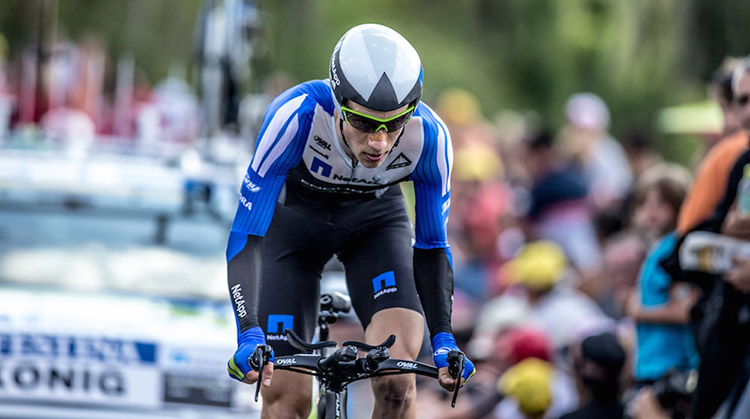
    KonigITT2

    By the penultimate stage of the race, König had soared all the way to 9th place, but a stellar time trial catapulted him even higher. He jumped to 7th overall in the Stage 20 ITT, to the surprise of many, though König himself had been anticipating success in the chrono all along.

    “To be honest I expected that. I looked forward to this TT as it was supposed to suit me well. And finally you know that’s the last real stage of the Tour and the race is almost done so I really wanted to enjoy it,” he said.

    In spite of an inability to train as planned in the run-up to the race, and further difficulty in the first few stages of the Tour de France, König finished 7th overall, among some very impressive company. Now with two Grand Tour Top 10s under his belt, he has cemented his status as one of the sport’s brightest young GC talents. After a short rest period following the Tour, König is now focused on a few late-season goals. He is currently racing in the USA Pro Challenge, and, perhaps unsurprisingly, this part of the season has not been without difficulties of its own, difficulties that saw him lose time on the opening day of the Pro Challenge, though he still has ambitions for the racing that remains.

    “On the way to Colorado I got some virus and spent two days in bed with fever so my GC ambitions are gone but I want to try to win at least one stage,” König said. “After Colorado I’m supposed to race the Tour of Britain, which I really like.”

    Somewhere in between all the racing, König has also had to find time to think about his future. He’s in the final year of his contract with NetApp-Endura, and having notched so much success (and shown some serious mental toughness battling difficulties along the way) over the past two years, he has plenty of suitors hoping to win his services in 2015 and beyond. While several big-name riders have signed in the past few weeks, König has taken his time weighing offers, but that may be about to change.

    “Things are moving ahead now so it’s going to be sorted out very soon,” he said.

    After delivering Top 10 performances in his first two Grand Tours, König’s impending decision will be closely watched around the sport. Having established himself as a capable GC contender not easily deterred from his goals, Leopold König is certain to make waves in whatever team kit he is wearing in 2015.

    -Dane Cash

    Photos by TNE/BrakeThrough Media.

  • Tour de France 2014 Post-race Impressions: Nibali Dominant, Others Ascendant

    Tour de France 2014 Post-race Impressions: Nibali Dominant, Others Ascendant

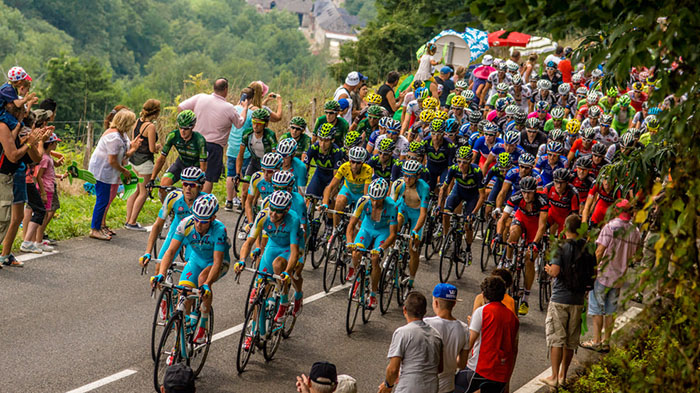
    Tour de France Wide

    Now that the 2014 Tour de France is officially in the books, there’s time to draw a few conclusions about what we’ve seen. Three weeks of racing offer enough storylines and takeaways for weeks of analysis, but I’ve distilled my impressions down to a select few major observations.

    A Worthy Winner

    Vincenzo Nibali did not want this race to be remembered as the Tour de France without Chris Froome and Alberto Contador, and the results he delivered in pursuit of a truly dominant performance were quite impressive. With four stage wins and several other Top 5s, a strong challenge for the polka dot jersey, and a gap of nearly eight minutes to his closest challenger, Nibali was in another universe compared to the competition in the race. It would have been nice to have seen him battling Froome and Contador, and as things stand right now, Froome is still the oddsmakers’ favorite for the 2015 Tour, but Nibali did all the right things to ensure his place in the history books as a worthy maillot jaune.

    Astana in Front

    We always knew that Nibali was a strong climber (one does not win the Vuelta and Giro without elite climbing ability) but he was up for it on every type of uphill challenge on the menu in this Tour, and avoided even one bad day. What’s more, he has developed into a top-notch time trialist, landing 4th in the Stage 20 chrono. And perhaps most importantly for this race, he displayed the sort of bike handling skills and racing savvy necessary to survive three weeks of riding on often rain-soaked and occasionally cobbled roads. There is a lot to be said for his ability to emerge unscathed from a Tour that dashed the hopes of so many other riders.

    A Lengthy Injury Report

    Speaking of those other riders: as much as Nibali did everything in his power to make this race his own, any rational analysis of this Tour has to include mention of the health issues that plagued so many riders and generated so many headlines. Alberto Contador was on fire this year and now he may not race again in 2014, and Chris Froome looked to be rounding back into shape before his multiple fractures took him out of the Tour. It would have undoubtedly been a very different Tour de France had they been in the mix in the mountains. They weren’t the only riders who suffered race-ending health problems. Mark Cavendish left the Tour on its very first day. Rui Costa was running well in the beginning of the race, but pneumonia hampered him as the Tour went on and ultimately he abandoned his campaign for a Top 10 overall. Andrew Talansky crashed and crashed again early on in the race and was just too banged up to continue riding at the level necessary to hang with the peloton. Andy Schleck suffered a serious knee injury which has put his next several months in doubt.

    Others made it to the Champs-Élysées but were noticeably lessened by ailments along the way. Among the big names in this camp were John Degenkolb, whose first several days were hampered by injury, Arnaud Demare, who battled sickness, and Richie Porte, whose tumble out of the GC Top 10 may have been partially due to a chest infection. In short, a number of big names struggled with health issues in this Tour de France. Those riders who did survive and thrive in the race are worth noting, but it’s important to view all of their successes in perspective.

    New Generation of Sprinters Here to Stay

    With four victories, Marcel Kittel was clearly the best “pure sprinter” in the race. We’ll never know how Mark Cavendish might have fared against the younger Kittel through three weeks of racing, but Kittel continues to assert himself as a dominant force in the top tier of fast men. This is his second straight year of four wins, but remember, he’s only 26! Alexander Kristoff, with a pair of stage wins, is planting his flag as a sprinting force as well, especially in the bunch gallops that follow long and/or rainy days. Peter Sagan is known as the rider to beat on the hilly days that end in reduced sprints, but Kristoff has carved out a niche of his own: he’s not as strong a climber as Sagan, but even flatter stages, if lengthy enough (and especially when wet) can wear out the other fast men, and it is in those scenarios that Alexander Kristoff shines brightest. Andre Greipel and Marcel Kittel were both in the mix on Stage 15, but Kristoff won anyway, much as he won the sprint finale of this year’s Milano-Sanremo despite the presence of Mark Cavendish.

    Peter Sagan may not have won a stage in this year’s Tour, but the nine Top 5 stage finishes that put him into the green jersey are undeniably impressive. It seems likely that with a stronger team, he’ll be able to focus more on winning and less on chasing down late moves; the question of “Where will Sagan land?” will be the biggest story of transfer season.

    Several other young non-winners were, nonetheless, strong performers on a number of stages as well. 22-year-old Bryan Coquard was always in the mix in the sprints, and 22-year-old Arnaud Demare and 25-year-old John Degenkolb delivered some nice results despite nagging ailments.

    A French Resurgence

    The 2014 Tour de France was a wonderful return to prominence for French cycling. Jean-Christophe Peraud, who has landed several impressive results in stage races in his career, put in a next-level performance to reach 2nd overall in cycling’s biggest event. He got stronger as the Tour went on, and benefitted from a top-notch team that also included 6th place finisher Romain Bardet, just 23 years old. A climbing specialist with serious talent and a high ceiling, Bardet now has a Top 10 in the Tour and in Liege-Bastogne-Liege on his 2014 resume (to go with several other nice results), and he should continue to develop as an uphill force.

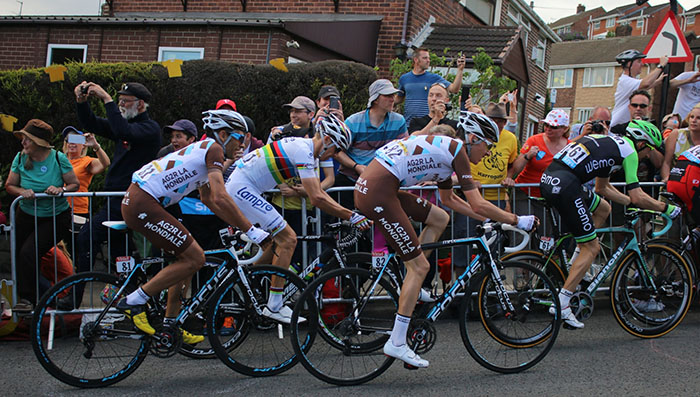
    AG2R Jenkin Road

    Thibaut Pinot finally took that step up that many expected after his 10th overall and stage victory in the 2012 Tour; a podium position in the Tour de France (ahead of Grand Tour winner Alejandro Valverde) will do wonders for his confidence. He seems to have gotten over his fear of descending, which was a major drawback to his game, but he developed into a much more well-rounded rider in other ways too, now seemingly capable of putting in a strong time trial and several straight good days in the mountains. He should only get stronger over the next few years.

    The GC riders weren’t the whole story for the French revival either. Consummate breakaway specialist Blel Kadri took a very long stage win in Gerardmer, and versatile Tony Gallopin spent time in the yellow jersey and later escaped Peter Sagan and a chasing pack to win Stage 11. He took an impressive victory in San Sebastian last year and continues to prove his wide array of talents that include climbing, soloing, and sprinting.

    Deserving Team Leaders

    BMC’s Tejay van Garderen recovered from a prior injury to race in this Tour, and then recovered from an early crash and a single bad day in the Pyrenees to land 5th on GC when all was said and done. 2013 was a rough year for the young American, who, despite winning both the Tour of California and the USA Pro Challenge, looked to have taken a step back as a Grand Tour rider in that year’s edition of La Grand Boucle. With Cadel Evans showing signs of slowing down, however, BMC backed van Garderen completely in this year’s Tour, and by consistently hanging with with the GC Top 10 types and then delivering a very strong time trial performance in the penultimate stage, van Garderen proved that he is back on track as a GC contender. He’s still just 25.

    Not far behind van Garderen on the GC leaderboard was Leopold Konig. Konig took a stage and 9th overall in the 2013 Vuelta, but 2014 hadn’t been going smoothly for the young Czech climber, who was slated for his first run at being a team leader in the Tour de France. A knee injury hampered his early season campaign and left him unable to prepare as well as he would have liked for this race. He overcame those obstacles and looked strong in the second and third week of the Tour, climbing to 9th on GC before the time trial on Stage 20. He proceeded to deliver the chrono of his life and jumped two more placings to finish 7th overall. It shouldn’t come as a complete surprise, as he has been delivering impressive time trial results somewhat under the radar over the last two years, but few expected him to land 5th in the ITT. If he can continue to show that sort of abiltiy against the clock, he will be a rider to watch in Grand Tours for years to come.

    Looking Ahead

    The last day of the Tour de France is not the last day of the cycling season! The Clasica de San Sebastian, a one-day race with a hilly profile designed to thrill, is less than a week away, with the Tour de Pologne and Eneco Tour soon after. Stay tuned for more previews, analysis, and rider interviews!

    -Dane Cash

    Photos by Adam Bowie, Sum_of_Marc, and Photigule.