The podcast previews the 2016 Volta a Catalunya, which boasts one of the strongest startlists in recent memory.
[powerpress]
The Classics may be in full swing now that Milano-Sanremo is in the bag, but some of cycling’s biggest GC stars will be busy doing what they do best this week in eastern Spain. Dane Cash and Cosmo Catalano discuss the Volta a Catalunya, among the oldest stage races in the sport.
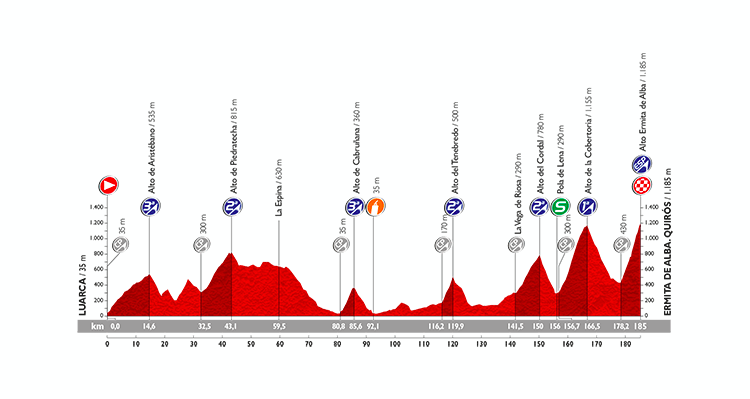
The Vuelta’s 16th stage will be among the hardest in the race. The road is angled sharply upward or downward for the majority of the day, and the finish is brutal.
The stage starts on a climb, the Cat. 3 Alto de Aristébano, which could spring the day’s main breakaway. If not, the agressors will have more opportunities to jump clear on the pair of uncategorized climbs that follow, or the Cat. 2 Alto de Piedratecha that comes next.
A less challenging stretch follows as the road slopes mostly downward from the top of the Piedratecha until about kilometer 80, where a short Cat. 3 awaits. Then comes another short climb, this time a Cat. 2, followed by a descent, a brief flat section, and then a trio of climbs that get progressively harder to close out the stage.
First up is the Cat. 2 Alto del Cordal, 8.5km at 5.7%. It’s more of a leg softener than anything. It’s followed by testy downhill into the vicious Alto de la Cobertoria, 9.8km at an 8.7% average gradient. The climb is harder than the metrics would suggest, as the average gradient is closer to 10% if you take out a less challenging final kilometer. Given the closeness of the GC battle, it would make sense for the red jersey hopefuls to initiate hostilities on this climb, even if there is a special-category ascent still to come. We’ll see if anyone has the guts to try.
One last downhill follows the Cat. 1 summit, and then it’s on to one of the most painful climbs in the race, the Alto Ermita de Alba.
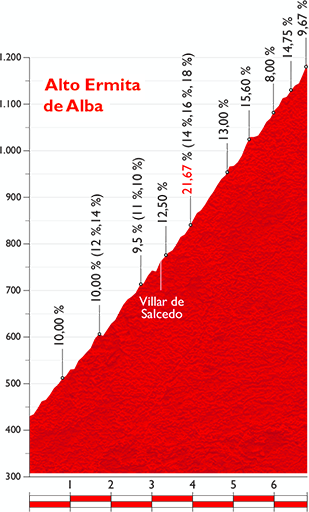
The gradients on the Alto Ermida de Alba are such that holding the wheel of the next rider in line will offer virtually no benefit—only the climbing specialists will be able to survive this climb.
It’s only 6.8km, but the average gradient is 11.1%, with a particularly nasty midsection that kicks up over 21% for a little while. It’s not exactly easy after that, with gradients still hovering in or around the double digits for the rest of the way up.
There are still a few mountain stages to come in the Vuelta, but Stage 16 is the last day with a summit finish, and there’s a long, flat time trial on the horizon, which means that the climbing stars need to put everything they have into this showdown to build up an advantage. In terms of the stage victory itself, this does look like a great profile for the long-range specialists, with climbs from the get-go that will favor the more uphill-oriented riders in the battle to get into the break, and then a wild finale that will be very hard to control. On the other hand, the smart play from any team other than Giant-Alpecin will be to drive a torrid pace over the climbs to weaken those who aren’t as suited to the gradients. I see the peloton vs. breakaway showdown as a 50-50 proposition.
Joaquím Rodríguez has been stronger than Fabio Aru on the past two stages in a row, and Stage 16 will be considerably harder than Stages 14 or 15 were, with some incredibly steep sections that should open up serious gaps between riders at the end of the day. Rodríguez attacked efficiently and effectively on Stage 15 and I wouldn’t be surprised to see him take Stage 16 as well—the last climb suits him perfectly. In any case, I see Aru as the other top favorite out of the GC men.
Rafal Majka is very much in the conversation as well. He couldn’t follow Rodríguez on Stage 15 but smartly rode in Aru’s wheel for a little while before letting the Italian go on ahead, only to pass him again before the line. I’m not sure this climb suits him all that well as it is just so steep, but he’s looking fresh and aggressive at the moment.
Nairo Quintana is certainly looking better than he did earlier in the race and will be an excellent candidate for stage success because of his GC position, far enough behind the leaders that he may get some breathing room if he tries an attack again. With 3 minutes over Quintana, Aru and Rodríguez can afford to let him go on the move. The same could be said for Esteban Chaves, who is likely to lose ground in the coming time trial. Chaves is riding into completely unknown territory right now, contending into the third week of racing at a Grand Tour, but he doesn’t look to be slowing down much.
Should the break contest the win, I’m looking at the same names that have come up in that conversation so far. Rodolfo Torres is my top pick of potential candidates for long-range success, as he combines form and climbing ability with a clear interest in going on the move. He was in an early breakaway on Stage 15 that was ultimately reeled in before the main move got clear, and I expect him to try again on Stage 16. The same goes for Fabio Duarte. This final climb is one for the real specialists, and that makes both Colombians dangerous.
I also expect Sky to try to get someone into the breakaway. Sergio Henao finished within 2 minutes of Purito on Stage 15 despite working for Nieve most of the afternoon. He’s clearly in excellent shape. Ian Boswell, Nicolas Roche, and Vasil Kiryienka could also try to get involved in the break.
On form and ability, Mikel Landa of Astana and Giovanni Visconti of Movistar are obvious candidates to take this stage from a breakaway if they get up the road, but the big question is whether they will be gunning for the move or helping team leaders—Landa has shown a willingness to do his own thing despite team orders, and Visconti rides for a squad whose chances of making a GC impact are dwindling, but it’s hard to predict what they’ll do.
The Europcar quartet of Jérôme Cousin, Romain Sicard, Pierre Rolland, and Cyril Gautier, BMC’s Darwin Atapuma and Alessandro De Marchi, Kenny Elissonde, and Bart De Clercq are other riders to watch out for as potential stage winners from a breakaway move.
Don’t miss the latest Recon Ride podcast episode, and be sure to follow @VeloHuman on Twitter for more Vuelta a España analysis. Stage 16 is followed by a rest day, so the preview of Stage 17 will be up on Tuesday. In the meantime, keep an eye out for a new episode of the Recon Ride.
Stage 11: Andorra la Valle › Cortals d’Encamp – 138km
The Vuelta a España visits Andorra for Stage 11, and some are calling it the hardest Vuelta stage ever. I haven’t reviewed every Vuelta stage since 1935 to really get a clear, definitive sense of whether that’s true, but it’s certainly going to be really, really hard.
It’s actually a very short stage at just 138km, and none of the climbs are longer than 12km. It’s the steepness and unceasing nature of the climbs that makes this stage such a challenge: from the moment they leave the start line until they cross the finish line, the riders will be ascending vicious uphill gradients or flying down harrowing descents.
The first half of the stage is composed of a trio of Cat. 1s, all of them followed by technical, steep downhills. Then comes the special-category Collada de la Gallina, 11.7km at 8.5%, after which the pack will descend on a gradient about as steep as the one they just climbed.
That quartet of brutal tests would be enough for most mountain stages, but the Vuelta’s 11th stage concludes with a leg-breaking one-two punch. First it’s the Cat. 2 Alto de la Comella, 4km at a whopping 9.5%, and after a quick descent it’s an uncategorized uphill run into the Cat. 1 finishing climb.
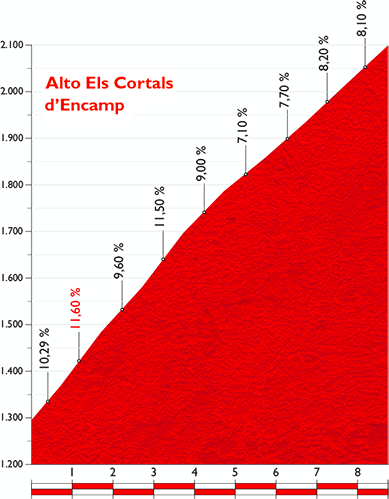
Stage 11 finally comes to an end atop the Alto Els Cortals d’Encamp, 8.7km at a 9.1% average gradient.
The Alto Els Cortals d’Encamp is a pretty regular climb—but it’s 8.7km at an average of 9.1%. Taking on two climbs of over 9% in such quick succession after such a tough day will probably see several big names see their GC campaigns go up in flames—there is just no way that everyone makes it up super-steep gradients unscathed.
On such a short stage, the pace is going to be high. In terms of trying to predict who will come out on top on this brutal day in Andorra, it’s already hard enough drawing conclusions from the earlier climbing stages in the race (which really can’t compare to this one), but the fact that this profile is pretty breakaway-friendly will further complicate things. However, this early queen stage will be a good opportunity for anyone who is feeling strong to make a huge statement in the GC fight, so we could see the top favorites testing each other early, and that will make it tough for a breakaway (as will the brutal finishing climb). That being the case, I see the top GC riders as better stage candidates than any individual breakaway candidates, especially since none of the long-range specialists have really established themselves just yet in this Vuelta.
Fabio Aru was the strongest rider on Stage 7 and among the strongest on Stage 9. I’d like his chances better if Vincenzo Nibali were still in the race, and if Mikel Landa were still a GC threat that could potentially go up the road and force others to chase, but Aru should still be a great pick for Stage 11. The final climb suits him well, brutally steep and long enough that he’ll really have a chance to launch a move from a little ways out as is his custom. I wouldn’t be surprised if some of his rivals were watching each other instead of him, giving him a chance to get up the road. The aforementioned Mikel Landa could have a chance as well if the team decides to let him go stagehunting.
Chris Froome did not look good on Stage 7 but came roaring back on Stage 9, suggesting that he’s starting to come around. This isn’t the sort of stage that screams Sky Train, but I think it’s sort of a misconception that Froome can only handle long, low-gradient climbs. He’s among the best in the world on the steep stuff, too, and he’s got more punch than people realize. I wouldn’t be surprised to see him tapping out his own pace early on the final climb only to leave his rivals behind in the finale. Nicolas Roche and Mikel Nieve have looked strong as well, and Sky, a squad that seems to understanding how little benefit there is to be gained from riding in a group on this gradients, will probably green light attacks if either is feeling good.
36-years-old or no, Joaquím Rodríguez has looked unflappable thus far in the Vuelta. He’s played things far more conservatively than expected, but he has also managed to stay right up there on all the important stages in the race. This stage might be a little too hard for the Spanish veteran, but if he can survive until the finale he’ll have a great place to go on the move. He’s a public proponent of Andorran cycling, and will be highly motivated to get something out of this one.
Nairo Quintana suffered a bit in the heat in the first week, but the Vuelta a España is entering cooler territory—and Quintana appears to be heating up. He’ll appreciate the consistently high gradients. Meanwhile, teammate Alejandro Valverde did not look quite as strong on Stage 9 as he had earlier in the week, so it could be Quintana’s time to make a statement.
Rafal Majka finished 5th on Stage 9 and probably has some intention of getting active here on Stage 11. While this profile will be a challenge, he should be fresher than many of the top climbers in the race, having ridden the Tour as a domestique and stagehunter instead of as a GC contender.
As amazing as Tom Dumoulin has been, I have a hard time seeing him staying in touch with the big climbing favorites on Stage 11. He can’t be ruled out, as he has defied expectation so far, but it would be a huge surprise. Esteban Chaves, on the other hand, should actually be pretty well-suited to the finishing climb, if he can recover from a bad day on Stage 9. Domenico Pozzovivo hasn’t been stellar in the Vuelta just yet, but if he can work his way into shape he should be able to get into the mix on this stage.
If the favorites are hesitant to put each other under pressure on this brutal stage, it wouldn’t be too much of a surprise to see someone sneak clear and win this stage from a breakaway. Stage 11 will have huge implications for the King of the Mountains Classification, so anyone with long-term KOM aspirations would do well to jump into the move.
We don’t have much to go on yet in terms of clear markers of climbing form from the long-ranges specialists, but Samuel Sánchez, Cyril Gautier, Jerome Cousin, Omar Fraile, José Goncalvez, Fabio Duarte, Rodolfo Torres, Daniel Navarro, Bart De Clercq, Gianluca Brambilla, Pierre Rolland, and Jurgen Van Den Broeck are all on the long list of riders with potential to play a role from afar on Stage 11.
Episode 25: Vuelta a España 2015 Show, Part II The 2015 Vuelta has finally reached its first rest day, giving the riders a chance to catch their breath, and the Recon Ride a chance to take stock of the race so far.
[powerpress]
Cosmo Catalano of Cyclocosm and Dane Cash of VeloHuman try to make sense of the craziness of the Vuelta a España, and look ahead to what should be a thrilling next six stages in Spain.
Episode 23: Vuelta a España 2015 Show, Part I The Recon Ride dives into the challenging parcours and the excellent startlist of the 2015 Vuelta a España.
[powerpress]
The final Grand Tour of 2015 is about to get underway, and the collection of talents preparing to make the start in Spain is impressive. Cosmo Catalano of Cyclocosm and Dane Cash of VeloHuman team up to present the first of three Recon Ride Vuelta episodes.
Stage 20 is the Tour’s final mountain stage, and the only stage in the race to feature two HC-rated climbs. Those two uphill tests are the only categorized climbs on the day, but they’re plenty challenging by themselves.
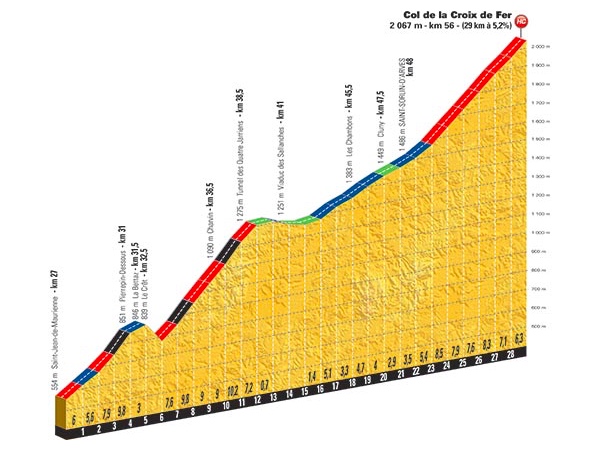
It’s a very short stage at just 110.5 kilometers, so expect a high pace all day. After a downhill run of 25km from the start the road angles upward in the form of the now-familiar Col de la Croix de Fer, though this time they approach the summit a different way.
The peloton may have gained some familiarity with the Col de la Croix de Fer after Stage 19, but that won’t offer much comfort during the 29km ride to the top.
The trip upward will span 29km at 5.2%, with a few steeper sections early on and then near the top.
After the riders crest the climb, they’ll head downhill for about 30 kilometers into a short stretch of flat road, which leads into the foot of the final mountain climb of the 2015 Tour de France: Alpe d’Huez.
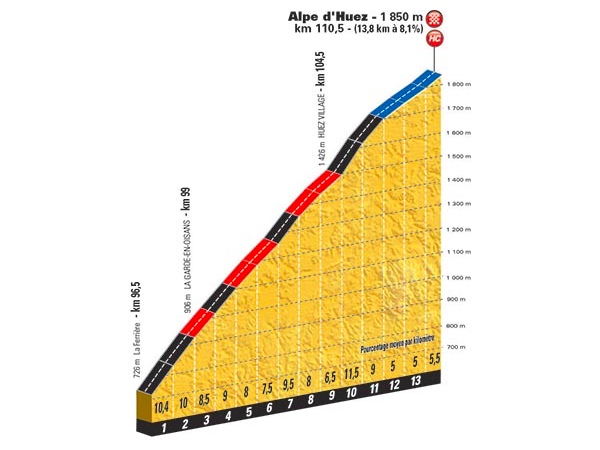
The legendary Alpine test is 13.8km in length with an 8.1% average gradient. It is at its steepest at the beginning of the climb and then with around 3 kilometers to go. Things even out a bit near the top for a final kilometer at just over 5%.
The Alpe d’Huez is the final opportunity for the climbers to leave their mark on the 2015 Tour de France.
The profile isn’t a terrible one for the early breakaway, and if a strong group gets up the road they will have a chance, but most of the big favorites from afar have spent a lot of time in the breakaways in the past two stages, and that could leave them low on fuel. The GC men, especially if they wind it up early to put pressure on each other, have a good chance of fighting it out for the final mountain stage in the Tour.
Nairo Quintana put some time into Chris Froome on Stage 19 and will look to do so again on Stage 20. For Froome, the goal is simply to not lose 2 and a half minutes on the stage. Froome didn’t look totally cooked on Stage 19 and was probably playing things conservatively, limiting the damage reasonably well—but the young Colombian is nevertheless closer to yellow than he was before. That could have Froome planning to take Stage 20 as safely as possible.
If he decides to attack Quintana, Froome’s an obvious danger for stage win, but with the Tour de France on the line, that seems like a risky proposition. What’s more, Quintana, benefiting a great deal from having Alejandro Valverde as a foil, might just be stronger now anyway. If this does come down to the GC favorites, it’s hard to see anyone challenging Quintana for Stage 20.
Alberto Contador will likely give it a shot. He’s way too far down on Froome to be a threat, but the podium is not completely out of reach, and a stage win would be something of a consolation prize for Contador, whose Tour has fallen very short of his expectations. He’s not strong enough to beat Froome and Quintana head-to-head but there’s a chance he’s given enough of space that that won’t matter too much.
Stage 19 winner Vincenzo Nibali could obviously have aspirations of breaking clear of the GC group once again, and he’s certainly looked stronger in the past few days than he did at the start of the race. But he’s not likely to get nearly as much breathing room as before now that he’s in contention for the podium, and he’s bound to pay somewhat for his efforts on Stage 19.
Robert Gesink sits nearly 9 minutes behind Froome on GC, and he has nearly 4 minutes of cushion to the next rider on the leaderboard. If he feels strong on the final climb, don’t be surprised if he tries to leave the GC men behind to go in pursuit of a stage win. Even if his bid fails spectacularly, he’s got plenty of time to lose to drop even one spot inside the Top 10.
Romain Bardet has enjoyed two great stages in a row, with a win on Stage 18 and a top 5 placing (and plenty of KOM points racked up) on Stage 19. He’s certainly strong right now, and he’s far enough behind on GC that he’ll be given some space if he wants to go for a long one. It’s hard to predict how he’ll play the stage—in his quest for the KOM title, the points on the Croix de Fer won’t actually be all that important if Froome ends up placing highly on the final climb. Bardet can’t afford to wear himself down too much and not be in contention for a decent placing at the finish. As such, his strategic decisions should be more focused simply on whether he thinks he has a better chance at a high stage placing (and the accompanying KOM points) from the pack, or in the break. Sticking with the peloton until the final ascent and then launching a move could be the best tactic. In any case, after two days of exhausting himself, Bardet is likely to be bringing a bit of fatigue into Stage 20, so it will be a big challenge for him to take a victory, especially with stronger GC favorites and fresher potential breakaway candidates having their eyes on the same prize.
Joaquim Rodríguez is in a similar boat, but he has not looked the best in the past two stages. The veteran racer could still recover, however, and unlike Bardet he conserved energy after the breakaway was reeled in on Stage 19, so don’t be surprised if he gives a long-range attack another go on Stage 20.
Pierre Rolland has plenty of form in this Tour de France but two days in a row of exhausting solo efforts won’t have left him with much energy to try for another on Stage 20. Then again, everyone will likely be tired and Rolland isn’t a threat to the overall, so he may find success if he saves energy by riding in the pack until the final climb, and then goes for a long one on the early slopes.
Thibaut Pinot stayed with the GC men for the entirety of Stage 20, which, first, suggests that he is feeling strong right now, and second, will likely leave him a bit fresher than Bardet, Rodríguez, and a number of other likely breakaway contenders. That could serve him well for a long-range move, though he hasn’t quite had the strength to turn in a victory so far.
Jakob Fuglsang was one of the few big-name potential breakaway favorites to completely save his energy on Stage 19, dropping out of the GC group early, and he’s looked strong enough in this Tour that he may have a chance with a long one on Stage 20. The question for Fuglsang will be whether he gives it a shot at all. Now that Nibali is fighting for the podium, Astana may call for all hands on deck in support of the Italian GC contender, which could leave Fuglsang playing domestique. If he goes on the attack, he’s a dangerous rider.
Rigoberto Urán, Rafal Majka, Ryder Hesjedal, Andrew Talansky, Cyril Gautier, Adam Yates, Serge Pauwels, Samuel Sánchez, Warren Barguil, Mathias Frank, and Rafael Valls are other names to watch for a long-range strike on Stage 20.
VeloHuman Stage 20 Favorites
1. Nairo Quintana | 2. Chris Froome | 3. Alberto Contador
Don’t forget: you can find plenty more Tour de France analysis in the most recent Recon Ride podcast episode. Be sure to follow @VeloHuman on Twitter for more commentary during the race, and check back for the preview of the final stage of the 2015 Tour after the conclusion of Stage 20.