Tag: NetApp-Endura

  • Leopold König on Overcoming Injury, Tour de France Success, and What’s Next in 2014

    Leopold König on Overcoming Injury, Tour de France Success, and What’s Next in 2014

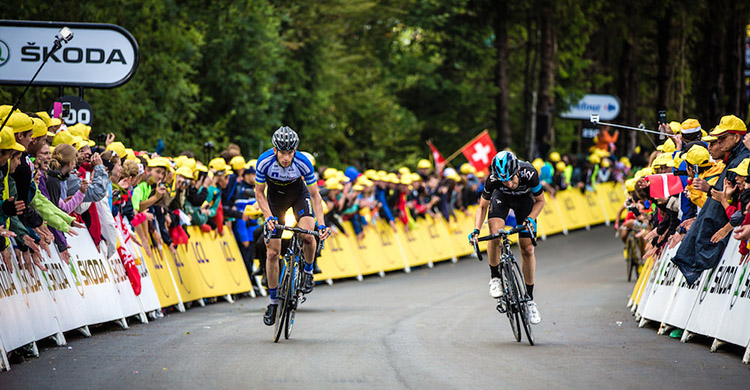
    Konig Climbing

    Given his 7th overall finish in this year’s Tour de France, you might think it’s been smooth-sailing all year for NetApp-Endura’s Leopold König, but almost from day one this season, things have not exactly gone according to plan for the rising Czech star. Having battled through a knee injury early in the year and a tough bout with illness more recently, 26-year-old König is now stateside to participate in the USA Pro Challenge, and he battled spotty reception in the Colorado mountains (much to the gratitude of VeloHuman) to answer a few questions about his fight to overcome one obstacle after another on his way to some fantastic results on the sport’s biggest stage, and what lies ahead for the rest of the year.

    König closed out his 2013 season on a high note, notching a stage win and 9th overall at the Vuelta a España, delivering the kind of performance for Pro Continental squad NetApp-Endura that announced to everyone just how deserving they were of a wildcard invitation. With an invite to ride in the Tour de France in 2014, it was fairly obvious what NetApp-Endura’s plan would be: build a team around this fast-rising talent to support his GC ambitions and again prove themselves worthy of their wildcard invite.

    With the sport’s main event on the horizon, König set out to build his form over the early months to be at his best for the big race in July, but just as the season began, his plans were derailed by a nagging knee injury.

    “Ligament issues,” he told VeloHuman. “It wasn’t too serious but the problem was the healing process lasted so long, and the only way to fix it was to relax the knee and not put any pressure on it. So that was very frustrating because we didn’t know how long it would last and finally it was more than one month, it was actually a long time.”

    Any plans to target a particular aspect of his skillset for improvement in training went out the window.

    “To be honest, there wasn’t much time to get specific training in, and we had to adjust a lot of training because I was one month off the bike and it was just a race with time to get to the Tour in time and to get prepared,” he said. “I actually just did one real training block in the Sierra Nevada that was more focused on climbing, and then I went to Bayern and the Dauphiné. So there wasn’t really much time to get specific training in for the Tour.”

    As might be expected, not being able to prepare for the biggest goal of his career was not easy for König.

    “I tried to stay relaxed and not really think about it but it was pretty hard to manage mentally because, as I mentioned, we didn’t know when I would be able to train properly, or when I would be able to race,” he explained. “I tried to stay relaxed but there were moments when it wasn’t really easy. But finally it worked out.”

    At last on his way back to recovery (he finished 4th at the Bayern Rundfahrt and 11th at the Critérium du Dauphiné), König took on his very first Tour de France with the added expectations that come with being a team leader.

    “Everything was much bigger, all the pressure, the media attention, and the things around are just bigger than the Giro and Vuelta, but we went into the Tour with a strong team and we wanted to prove to the organizers that the wildcard we got was worth it,” he said.

    König’s Tour campaign itself got off to a rocky start. He lost more time than many of his GC rivals on the cobbles and then crashed hard on Stage 8, losing several minutes. At the end of Stage 9 he was already more than nine minutes off the lead and sitting in 28th place. However, from then on he put in one great ride after another (including a 3rd place performance on Stage 13), climbing higher and higher up the GC leaderboard as the Tour became more mountainous. König attributes his strong second half to his endurance and his ability to get into a groove.

    “I think that’s just the way my body is built,” he said. “I’ve done just 2 Grand Tours but I can feel that every week I’m improving and feeling better. The first ten days of the Tour were especially hard and unlucky for me but then I just started to feel day by day more relaxed and powerful.”
    KonigITT2

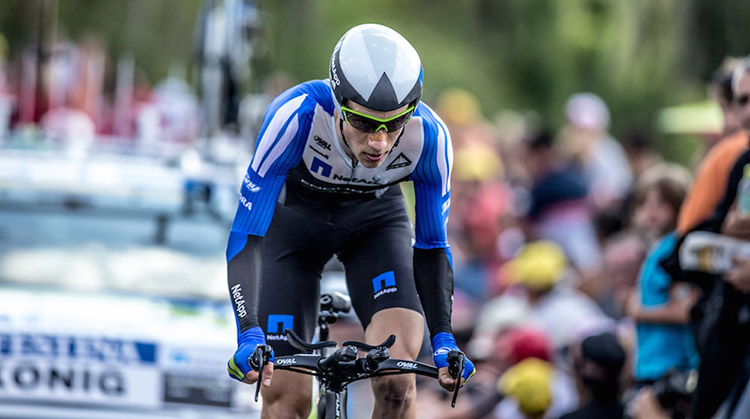
    By the penultimate stage of the race, König had soared all the way to 9th place, but a stellar time trial catapulted him even higher. He jumped to 7th overall in the Stage 20 ITT, to the surprise of many, though König himself had been anticipating success in the chrono all along.

    “To be honest I expected that. I looked forward to this TT as it was supposed to suit me well. And finally you know that’s the last real stage of the Tour and the race is almost done so I really wanted to enjoy it,” he said.

    In spite of an inability to train as planned in the run-up to the race, and further difficulty in the first few stages of the Tour de France, König finished 7th overall, among some very impressive company. Now with two Grand Tour Top 10s under his belt, he has cemented his status as one of the sport’s brightest young GC talents. After a short rest period following the Tour, König is now focused on a few late-season goals. He is currently racing in the USA Pro Challenge, and, perhaps unsurprisingly, this part of the season has not been without difficulties of its own, difficulties that saw him lose time on the opening day of the Pro Challenge, though he still has ambitions for the racing that remains.

    “On the way to Colorado I got some virus and spent two days in bed with fever so my GC ambitions are gone but I want to try to win at least one stage,” König said. “After Colorado I’m supposed to race the Tour of Britain, which I really like.”

    Somewhere in between all the racing, König has also had to find time to think about his future. He’s in the final year of his contract with NetApp-Endura, and having notched so much success (and shown some serious mental toughness battling difficulties along the way) over the past two years, he has plenty of suitors hoping to win his services in 2015 and beyond. While several big-name riders have signed in the past few weeks, König has taken his time weighing offers, but that may be about to change.

    “Things are moving ahead now so it’s going to be sorted out very soon,” he said.

    After delivering Top 10 performances in his first two Grand Tours, König’s impending decision will be closely watched around the sport. Having established himself as a capable GC contender not easily deterred from his goals, Leopold König is certain to make waves in whatever team kit he is wearing in 2015.

    -Dane Cash

    Photos by TNE/BrakeThrough Media.

  • VeloHuman Up-and-comer Q&A Series: NetApp-Endura’s Sam Bennett

    VeloHuman Up-and-comer Q&A Series: NetApp-Endura’s Sam Bennett

    Sam Bennett recons the cobbles at Paris-Roubaix. Photo: BrakeThrough Media
    Sam Bennett rides the cobbles at Paris-Roubaix. | Photo: BrakeThrough Media

    VeloHuman is all about getting the scoop on which riders will be starring in tomorrow’s races, and in that vein, VH is kicking off a Q&A series with some of pro cycling’s most promising up-and-comers. 23-year-old Sam Bennett is one of the sport’s fastest-rising young sprinters. Hailing from Ireland, he recently joined Pro Continental squad NetApp-Endura and he’s already racked up several excellent results in 2014. VeloHuman talked to Sam this week about finding confidence on cycling’s biggest stages, surviving on the cobbles, Tour de France selection, and a lot more!

    VH: Sam, you came over to NetApp-Endura after landing some great results in Ireland, the Tour of Britain, and the Under-23 World Champs, but now you’re racing high profile events pretty much every week. How did you handle that transition at first?

    SB: It’s strange, you come into NetApp-Endura and look at all the guys around you, they’ve been pros for so long. I kind of found it hard to try and settle in. I’m not really used to changing teams because I was with a team for three years, and that team it was full of Irish guys, so it was a bit strange to me at first. And then jumping into races that are a high standard all the time, it was difficult. I was trying to find a medium between respecting guys and getting myself into the right position, not letting myself get too intimidated. The first stage of Qatar, when I had to do a bunch sprint, I felt tired in the end with crashes and that and just beforehand I was having a moment of panic, like, “I can’t do it, I can’t sprint.” Having a team leading me out, I wasn’t really used to having full support. The pressure was weird because I didn’t want to let the guys down, them leading me out and then not finishing up the job, when they could have gone and done it themselves and probably done better—but I stepped up that time and, okay, it didn’t turn out how we wanted [Sam came in 14th on the stage] but we got the young rider’s jersey that day, just for one day. And after that, I had no problem. Also, I’m finding the racing is a lot more controlled, so I’m actually finding it easier than racing in lower ranked races with amateurs. It’s suiting me a lot better because I sit in the bunch and conserve and then I do my thing in the sprint, so in that respect I’m finding it not a lot easier but easier to do the job.

    VH: You had some success in the Tour of Qatar, you were 3rd in the last stage in the Tour of Oman, and then you won the Clasica de Almeria. Did you have any feeling at the beginning of the year that you were going to have that kind of success that early?

    SB: I always set my targets high. I always expect the very best from myself; I put a lot of pressure on myself, so I almost expect myself (in my head) to try and win every race I go into—though obviously that’s not going to happen. I always mean to do the best performance I possibly can, so if it does come along, I kind of feel more relief at times than excitement. I’m always looking to try and get the next result. It’s fantastic to get it, I was really, really happy and delighted to get those results.

    VH: A bit later you raced Gent-Wevelgem, Flanders, Scheldeprijs and even Paris-Roubaix. Do you consider yourself a strong rider for the cobbles? Is that an area that you will continue to focus on in the future?

    SB: In the future, yeah its something I’d love to compete in, though at the moment I find it a bit strange, I can sprint better and position myself better when I come to the final but I don’t see my engine as being as good as at the end of last year; I don’t feel as strong in that respect. If I can get that form back . . . I also don’t want to lose speed by gaining form. I don’t know if that might sound stupid, but I’m afraid that by getting stronger I might lose that speed you need for sprinting. That’s how I get my results, so I’m going to try to keep that. But yeah, sure, if I could try to pull off a result in a classic, it would be absolutely amazing and I’d absolutely love to.

    VH: You finished Paris-Roubaix in your first start. How hard was that?

    SB: It’s strange, I think each section is almost like you’re positioning yourself for a bunch sprint, so I found that once you positioned yourself right, you were sorted for each cobbled section almost. I think for the first hundred km or so, I was going in the first ten or twenty so I was kind of comfortable, but then I hit the deck. I hit the side of the cobble and fell into a field. And then it was full gas because the next section you had to be up, so I just couldn’t get back in. I kind of spent the day riding on my own tempo. It was hard but . . . I don’t know because I didn’t really get dropped trying to hang in until I blew. It was really hard to finish but I got there. I’d love to see how long I could have held on until I blew but I was happy with that. I was delighted that when I got to the velodrome that it wasn’t closed off, and I was able to do my laps. It was a great feeling. That day, I’d say I spent 80% of the time in the gutter and not actually on the cobbles, I don’t know how I didn’t get a puncture.

    Sam Bennett at Bayern-Rundfahrt; he sprinted to victory in the fifth stage. Photo: TNE/Stiehl
    Bennett at Bayern-Rundfahrt; he sprinted to victory in the fifth stage. | Photo: TNE/Stiehl

    VH: You must have recovered quickly: you won Rund um Köln only a few days later. Then, you won a stage at Bayern-Rundfahrt at the beginning of this month. Has there been one particular thing that you’ve learned this year that has contributed to these big results?

    SB: One big thing would be not to get intimidated by bigger riders and just to focus on what you can do. I think that’s the most important thing you can do as a sprinter. You can’t be thinking, “Oh, this guy’s quicker.” For each individual sprinter, I think you do think and I think you have to think that you’re the fastest guy on the whole planet. You don’t go around saying that but you have to believe it even if it’s not true. You have to have that confidence to keep putting yourself in the right place. I try to keep getting up there and keep getting it right; if you keep putting yourself up there in the right place, eventually the result has to come, eventually it will happen.

    VH: Has there been a specific skillset that you’ve been able to improve this year?

    SB: This time last year my biggest problem was getting to the finish. At the end of last year, all I did was three-to-five minute efforts to try and get myself into position to sprint and if I got there fresh I’d be able to sprint better. Getting to the finish, getting into the right place just before the sprint starts . . . There’s two parts of sprinting: there’s getting to the finish and then there is winning the sprint.

    VH: I’m sure you’re being asked this a lot right now, but do you have a sense of your chances of getting selected for the Tour de France squad, or what you can do to make that more likely?

    SB: Yeah (Sam laughs) . . . Really I absolutely have no idea. Everybody keeps asking me and I think there’s a lot of pressure. I personally don’t know how I’d get through three weeks at that standard. Its another level again on the races I’ve been doing. It’d be a very big ask, especially in my first year as a pro, and I think there’s a lot of guys in the team that are a lot stronger and will be capable of finishing and doing a better job for Leo [NetApp-Endura’s GC rider Leopold König]. I don’t know how it will go. I can’t really put a lot of pressure on . . . If it comes around it comes around, I’ll be absolutely delighted, take the bull by the horns and give it everything I’ve got, but I won’t put any pressure on in my first year.

    VH: Whether or not you do end up riding the Tour de France, what are your other goals for 2014?

    SB: I’d love to get really high up in the Europe Tour. I was pretty close there recently, I don’t know if I’ve dropped off in the last week or two, I haven’t looked at it [Sam is currently 4th]. If I could lead the Europe Tour by the end of the year I’d be delighted with that. I’ve always wanted to gain consistency in my performances and in my riding and in my form. I could never get that in other years because of sickness and injuries and all that. I always had a lot of bad luck so I always said consistency is key. This year, I actually have consistency, and you can see that in the Europe Tour, so if I can take that it would mean a lot for me, for my head and for my confidence. Also the Tour of Britain, last year it was a race that kind of got me where I am, I did the business to get a pro contract. It’s a race that means a lot to me so it’d be a race that I’d love to go back and perform in.

    VH: One last question. Is there one race, maybe you grew up watching or that you’ve ridden now, that you hope more than any that you will win at some point in your career?

    SB: It’s a tossup between last stage of the Tour de France, the Champs-Élysées, and the World Championships. Champs-Élysées, I’ve always watched and replayed that sideview of the riders sprinting flat out. I’d love to be able to have that video recording of me winning that last stage of the Tour de France, to see how it is from that angle. It would be absolutely amazing. The World Championship, to be the absolute best in the world, knowing that that day, nobody in the world could beat you, it’s possibly a feeling like no other, and then you get to wear that jersey as a reminder for the next year. That would be unbelievable.

    Sam’s next goal is the Irish National Championship Race, which he acknowledged would be a big challenge against talented riders like Martyn Irvine and four-time champ Matt Brammeier. Whoever wins the jersey, it will be a major accomplishment in this amazing time for Irish cycling, with riders like Bennett, Daniel Martin, Phil Deignan, and Nicolas Roche making headlines (Sam also named Jack Wilson, Ryan Mullen, Michael O’Loughlin, and Sean Hahessy as Irish riders to keep an eye on in the near future). Plenty of eyes will be on Bennett himself as he takes on the second half of the year, gaining confidence and experience with every race.

    -Dane Cash