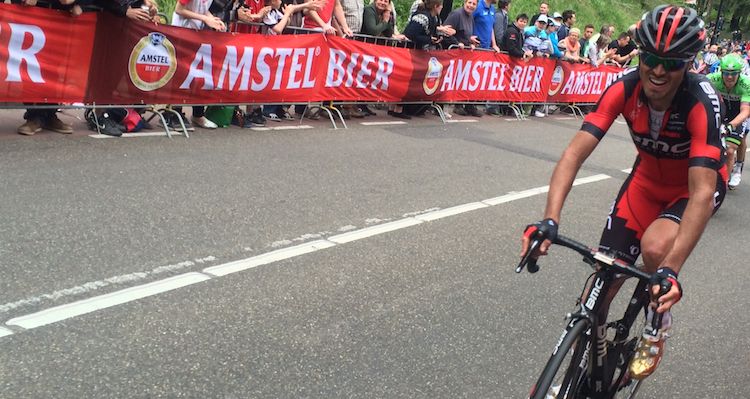
The Classics calendar leaves the rough cobblestones of Flanders and northern France behind for the short, steep bergs of the Netherlands Sunday at the Amstel Gold Race. The uphill chargers will face off on a bumpy parcours in the Limburg province, the first of three puncheur-friendly WorldTour races often called the “Ardennes Classics” (though the Amstel Gold Race doesn’t actually go through the Ardennes forest.
The Route
Even at a long 251 kilometers in full, with 34 classified climbs from start to finish, the Amstel Gold Race is a roller-coaster ride throughout. The trip from Maastricht to Berg en Terblijt is one of constant ups and downs, with plenty of road furniture along the way to boot.
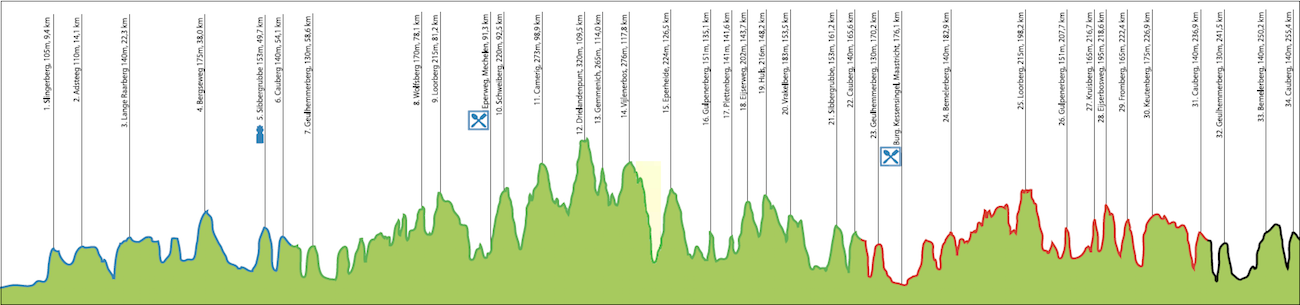
On paper, the route and profile look perfect for aggressive racing, and recent editions have seen successful long-range attackers. But historically, this race has quite often been all about the very last uphill test, the Cauberg. It’s a little over a kilometer long at just under a 5% average gradient, but with some seriously steep stuff in the middle. From the top of the final ascent (the peloton will visit the iconic climb multiple times on the day) of the Cauberg, it’s still almost two kilometers to the line, a relatively recent route alteration that requires those who get away on the last slope to maintain their gap over a flat stretch before the finish.
The Contenders
Whether this race is won with a long-range attack, a charge up the Cauberg, or a finishing sprint in the final drag, explosiveness is the critical trait for any would-be contender in the Amstel Gold Race: explosiveness to get clear in a breakaway attempt, to launch up the last climb, or to win a bunch kick in the finishing straight. The Amstel Gold Race is a puncheur’s playground.
Philippe Gilbert is the peloton’s most successful active Amstel Gold Racer, and generally, the sport’s dominant figure on the Cauberg climb. He’s won this race three times, and won his rainbow jersey atop the Cauberg in 2012. This race suits him down to the ground, and his 3rd place in the recent Brabantse Pijl suggests he’s in good shape. Still, he’s not the Philippe Gilbert he once was, and all eyes will be on him in the last few kilometers. He won’t be able to slip away. As strong as he is here, this startlist is packed with hungry uphill specialists, it won’t be easy for him to get clear even on his favored terrain, and a few of the other likely contenders could probably beat him in a sprint if he can’t drop them. He’s the oddsmakers’ favorite for obvious reasons, but winning a force Amstel will be a real challenge. Regardless, having Samuel Sanchez, Greg Van Avermaet, and Ben Hermans around to launch attacks does give BMC plenty of cards to play.
Alejandro Valverde has never won here, but his uphill burst is one of the best in cycling, and his ability to win a sprint even in a flat finish makes him particularly dangerous. In blazing form after a three-stage-win Catalunya, Valverde has a terrific chance of winning this race.
Michal Kwiatkowski, 5th last year, also has a strong uphill burst and an excellent finishing kick. One advantage he may have even over the versatile Alejandro Valverde in this finale is a talent for late solo moves. He earned his Worlds title with a brilliant late attack in Ponferrada, and with the finish line still over a kilometer from the top of the Cauberg, his time trialing skills will come in very handy.
Simon Gerrans is perfectly suited to this parcours, but he is probably still a bit lacking in the form department after an early season injury. Orica-GreenEdge will likely put their faith in Michael Matthews instead, who just landed his second straight 2nd-place result in Brabantse Pijl. If the punchier riders can’t get separation, Matthews has a great chance of winning this race in a sprint.
Joaquim Rodríguez has the punch to thrive on the Cauberg, and showed incredible form in Pais Vasco. The flat stretch that follows from the top of the final climb is not great for his skillset but he may be strong enough to open up a winning gap on the uphill drag. Teammate Daniel Moreno also has plenty of punch, and a decent sprint as well.
Sergio Henao is another talented climber with a fair bit of punch, and he showed strong form in the Basque Country. Daniel Martin would probably fare better with a purely uphill finish too, but he does have a nice finishing kick if he manages to get into a small group in the finale—Tom-Jelte Slagter is another option for Cannondale.
With an impressive trio of Jelle Vandendert (twice 2nd here), Tony Gallopin, and Tim Wellens, Lotto Soudal will almost certainly be in the mix for the win. Wellens is a great candidate to go from afar. Giant-Alpecin’s Tom Dumoulin is another great long-range candidate. His elite soloing ability combined with an ever-improving finishing kick make him a terrific outsider for victory.
Lampre’s Rui Costa and Diego Ulissi, Wanty-Groupe Gobert’s Enrico Gasparotto, Astana’s Vincenzo Nibali, Tinkoff-Saxo’s Roman Kreuziger, Trek’s dangerous trio of Bauke Mollema, Julián Arredondo, and Fabio Felline, CCC’s Davide Rebellin, and AG2R’s Carlos Betancur and Jan Bakelants are others hoping to get into the mix.
VeloHuman Top 10 Favorites
Winner: Michal Kwiatkowski
Podium: Alejandro Valverde, Philippe Gilbert
Other Top Contenders: Michael Matthews, Joaquim Rodriguez, Jelle Vanendert, Tim Wellens, Daniel Moreno, Sergio Henao, Tom Dumoulin
Be sure to follow @VeloHuman on Twitter for more analysis.
-Dane Cash
Photo by By Jakub Cerveny (CC).
Leave a Reply